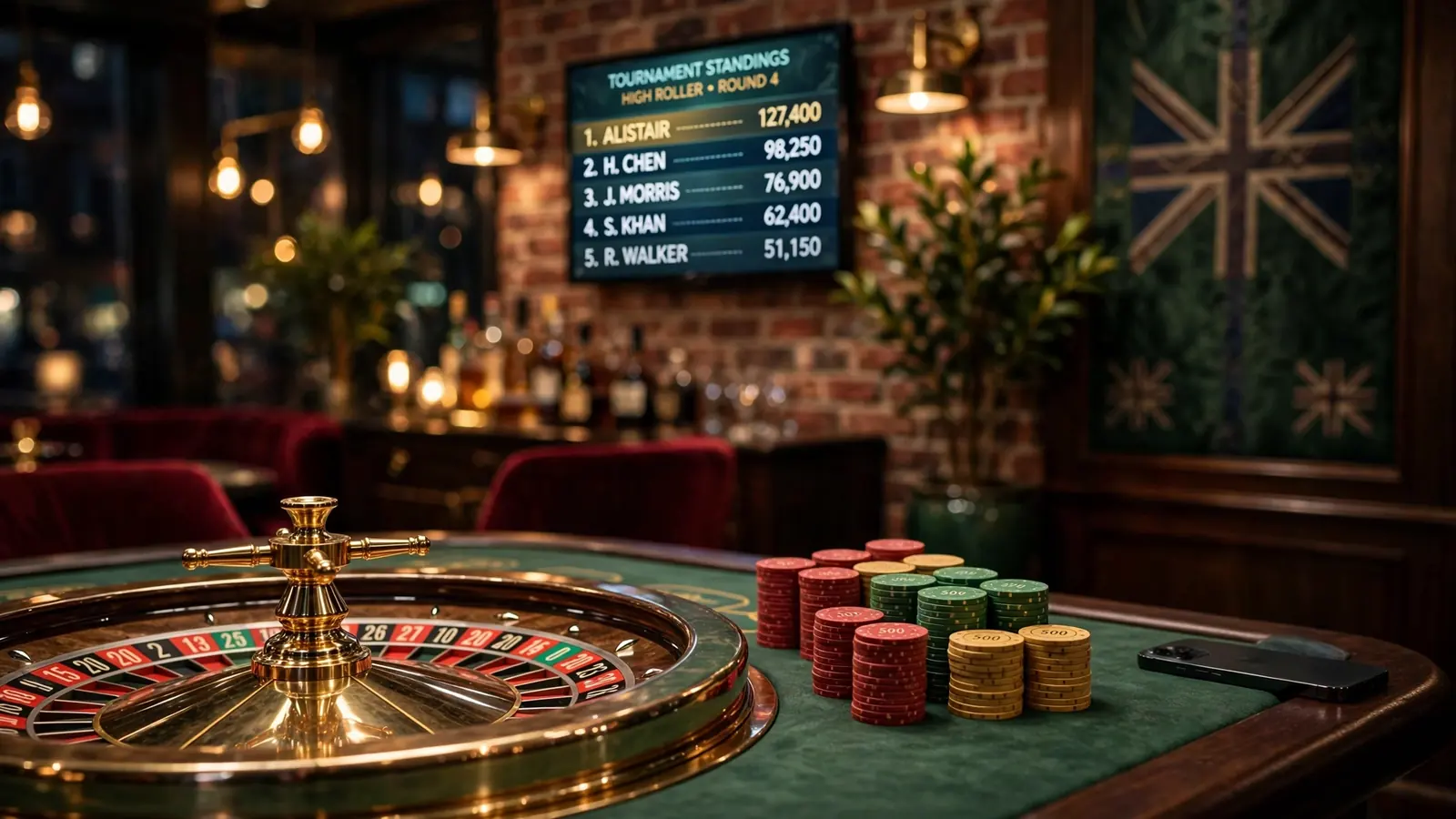
Live Casino UK: How to Compare Sites and Tables
 Available in GB
Live casino combines a human-run game with on-screen betting controls, so comparing sites means looking beyond the stream.

Table of Contents
- How Live Casino Works Online
- The UK Rules Behind Live Casino
- Playing Live Casino for Real Money
- Live Casino Games and the Slot-Stake Distinction
- Assessing Live Casino Sites Without a Promised Top Ten
- Live Blackjack: Decisions, Insurance and Table Limits
- Deposits, Welcome-Offer Stages and Live Dealers
- Live Casino Bonuses: The Terms Behind the Headline
- Live Dealer Software and What the Lobby Reveals
- Live Casino Offers: Read the Conditions, Not Just the Headline
How Live Casino Works Online
A live casino is a video connection to a game being run by a human dealer, with software linking the table to a player’s screen. It is different from a computer-generated casino game: the cards, wheel or other physical equipment are presented in a real studio, while the site supplies the controls for placing bets and following the round.
The stream is the visible part of the arrangement, but not the whole thing. Cameras show the dealer and the equipment, while an interface displays the betting options, the current state of play and the balance associated with the session. When a round opens, the player selects a permitted wager on screen. The dealer then conducts the action, and the system updates the result so it can be reflected in the account.
That division of roles matters. The dealer does not take instructions from each player individually; the table follows a defined sequence, and the software accepts choices only while the relevant stage is open. A player watching the stream is therefore joining a shared table, not having a private game with the dealer. The view may make the experience feel personal, but the underlying process is structured and timed.
From table to screen
The studio’s cameras capture the table and send video to the online platform. The player’s device receives that stream and displays it alongside the controls. Depending on the table and layout, the screen may include close views of cards or equipment, a wider view of the dealer, and an area for the betting interface. The presentation can change from one table to another, but the basic principle remains: video shows the physical game, and software manages the interaction.
There is a small but important gap between what happens at the table and what appears on screen. Video has to travel across networks, and the interface has to keep pace with the game. That means the picture is not a direct window with no delay. Live tables account for this by moving through clear stages: betting opens, the dealer carries out the round, the result is entered or recognised by the system, and the next betting period begins.
Low-Volatility Slots in the UK: How They Play
I find that staged rhythm is the easiest way to understand the format. The stream supplies the atmosphere; the interface supplies the rules of participation. If the video pauses or the connection becomes unstable, the controls and the picture may not feel perfectly synchronised. A player should rely on the information shown by the table interface, not assume that a frozen image means the game itself has stopped.
What “live” changes
The live element changes how the game is presented, not the fact that it remains an online activity. The dealer is physically present, but the player is still interacting through a device and a software interface. There is no need to speak to the dealer for a routine action: selections are normally made through the on-screen controls, and the dealer proceeds according to the table’s sequence.
Some tables also provide chat. It can add a social layer, but it is separate from the mechanics of placing a wager. A message does not replace a control, and a dealer’s response does not change the result of a round. The main job of the interface is to make the current stage clear and record a player’s selections before that stage closes.
The stream can also create a stronger impression of immediacy than a standard digital game. The cards are dealt in view; the wheel is physically spun; the dealer’s actions are visible. Yet the player is not controlling the studio equipment. The platform mediates every action, from presenting the available choices to confirming the outcome. That is the practical meaning of live: a real dealer and physical table delivered through an online system.
The connection is part of the experience
A stable internet connection helps keep the video and controls usable, but a good picture is not the only concern. The table needs to communicate whether betting is open, whether a selection has been accepted and when the round has moved on. Those signals matter more than cinematic presentation. A polished stream is still only useful if the player can understand the game state.
If the video pauses or the connection becomes unstable, rely on the information shown by the table interface rather than assuming the game has stopped.
Device layout can affect that clarity. On a smaller screen, controls and table information may be arranged differently from a desktop view. The stream may occupy less space, or some information may sit behind a panel. It is worth taking a moment to understand where the controls and status indicators appear before joining a round. No need to rush.
The human dealer is not a guarantee that every part of the experience is informal or flexible. The game follows its rules, and the software applies the table’s timing and records the choices. A live table can feel conversational while remaining tightly managed. That is not a contradiction; it is how the format combines a studio broadcast with an online product.
Payments and boundaries
One practical UK rule is straightforward: gambling with a credit card is prohibited. That restriction applies to gambling activity, including online play. The payment method should therefore be considered before a session begins, rather than treated as a detail to sort out mid-session.
Live presentation can make play feel absorbing, particularly when rounds follow one another without much pause. The stream does not change the basic financial risk. Wagers can be lost, and only money that can be afforded to lose should be put at risk. Keep the decision separate from the atmosphere of the table.
In short, a live casino joins a real table to a digital interface. The dealer provides the visible action; the software carries the player’s choices to the game and returns the result. The screen is a window, not the table itself.
Keno Online Casinos in the UK: How the Game Works
Recommended online casinos
- NightLuckBonus: Welcome Pack + 805% Up To 6400€ + 280 FS · Payout speed: 1-3 business days
- SlotoSportBonus: 500% up to £ 10 200+ 777 FS · Payout speed: 1-3 business days
- SpinFormulaBonus: 550% Up To £15,000 + 550 FS · Payout speed: 1-3 business days
- x3betBonus: Welcome Pack 100% Up to £1.000 + 200 Free Spins · Payout speed: 1-3 business days
- Revery PlayBonus: 100% up to€1,000+ 100 FS · Payout speed: 1-3 business days
- ZombillionBonus: Welcome Pack 250% up to £4000 + 200 FS · Payout speed: 1-3 business days
- ChanzeBonus: Slots Welcome Bonus #1 200% up to €500 · Payout speed: 1-3 business days
The UK Rules Behind Live Casino
A live casino is still a remote gambling service when its tables are streamed to a screen. The dealer may be working in a studio elsewhere, but the regulatory question is not settled by the studio’s address or the location of the equipment. For gambling offered remotely to consumers in Great Britain, the UK Gambling Commission’s remit applies regardless of where the key equipment is based.
That distinction matters because the live presentation can make an online service feel like a separate kind of venue. In regulatory terms, it remains part of commercial gambling. The UK Gambling Commission oversees gambling activity in the UK, including online casinos, and it is the only body regulating commercial gambling across Great Britain. A live table does not sit outside that framework simply because a human dealer appears on screen.
I have found it useful to separate the visible product from the legal responsibility behind it. A stream shows the dealer, table and game interface. The operating licence concerns the business providing the gambling service. Those are different layers. A studio’s location, the software on screen or the name attached to a table does not by itself establish which business is responsible for offering the service to a customer in Great Britain.
Businesses and individuals
The Commission grants operating licences to businesses and personal licences to individuals operating in Great Britain. The distinction is practical: one licence is held by the organisation conducting the business, while the other is issued to an individual. They are not interchangeable credentials, and an individual’s licence does not replace the operating licence required for the gambling business.
The UK Gambling Commission grants operating licences to businesses and personal licences to individuals; these are not interchangeable credentials.
That is why licensing language in promotional material needs to be read carefully. A statement about a person, a supplier or a live studio is not the same as confirmation that the casino business itself has the relevant operating permission. The licence framework attaches responsibility to the operator, not merely to the visible dealer or the technology that delivers the game.
From the industry side, this is one of the points that gets blurred in marketing. “Licensed” can be made to sound like a general quality label, although the important question is which entity holds what kind of permission and for which activity. The Commission’s role is not a badge issued to every component in a broadcast. It regulates commercial gambling and issues the relevant licences to businesses and individuals.
Great Britain and the wider UK
The terminology also deserves care. The Gambling Act 2005 applies in England, Wales and Scotland, but not Northern Ireland. The Commission regulates remote gambling offered to consumers in Great Britain, and operators selling into that market must meet the local licensing requirement even if their equipment or business premises are elsewhere.
This is not a technicality about servers. It prevents a company from treating its foreign location as a reason that British customers fall outside the regulatory framework. Where a remote operator offers gambling to consumers in Great Britain, the relevant issue is the service being offered into that market, rather than the geography of the equipment supporting it.
References to “UK rules” are common in everyday writing, but the legal scope should not be casually stretched from Great Britain to every part of the United Kingdom. Northern Ireland has a different legislative position under the Gambling Act framework. For a person assessing an online casino intended for Great Britain, the key regulator is the UK Gambling Commission.
What the framework means for live play
The rules apply to the gambling activity, not just to a particular game format. A business offering live roulette, blackjack or another casino product remotely is still offering commercial gambling online. The dealer’s presence does not create an exemption, and the use of a separate studio does not transfer the operator’s regulatory responsibility to the studio.
Best RTP Casino Slots in the UK: How RTP Works
In my experience, this is where the market’s presentation can distract from the basic structure. The broadcast may feel personal; the licence relationship is institutional. The Commission regulates the service and authorises businesses through operating licences, while personal licences apply to individuals operating in Great Britain. That division is the foundation, not a description of how a particular table works.
For customers, the broad legal position is straightforward: online gambling in Great Britain is provided within a locally regulated framework, and a business serving that market needs the appropriate Commission licence. This is not a claim that every site using familiar casino language is authorised. Nor does a foreign address, a studio logo or a provider’s name answer the licensing question. Those details describe parts of the service; they do not replace the operator’s legal status.
The framework is market-wide. It does not depend on whether a customer chooses a live dealer rather than a digital game, or on whether the tables are shown through a dedicated studio. What matters here is who offers the gambling and whether the business holds the operating permission required for Great Britain. Individuals may also hold personal licences in their operating roles, but that does not turn their permission into the company’s licence.
That separation is easy to miss when the product is designed to look like a room with a dealer. Underneath the presentation, it is a remote gambling service with a named business responsible for providing it. The regulator’s reach follows the service into the British market. Studio location is not a loophole.
Playing Live Casino for Real Money
Real-money play changes the weight of each decision. A chip on screen is not an abstract score: it represents money that can be lost. I treat the balance shown in a live casino as a spending balance, not as a measure of how close a session is to paying off. That distinction matters most after a losing run, when the temptation is to keep playing until the result feels corrected.
A budget works best when it is set before opening a table. It should come from money left over after essential spending, and it should be an amount that can be lost without affecting bills or other commitments. Once that limit is reached, the session ends. Raising it mid-session turns a planned cost into a reaction to events at the table.
Fast payout online casinos in the UK: what to know
I have seen the logic of chasing losses presented as persistence: another hand, another spin elsewhere, or a higher stake might recover what has gone. In practice, the previous loss does not improve the next wager’s prospects. Increasing stakes to get back to a target can instead make a short setback more expensive. A stopping point is useful precisely because it does not depend on whether the last result was a win or a loss.
Time matters too. Live tables can make play feel continuous, with the next opportunity appearing before there has been much space to reconsider. A pause between sessions helps separate a fresh decision from the urge to repair the previous one. If attention is slipping, or a planned limit has been reached, staying at the table is not a financial strategy. It is simply more exposure to risk.
Before depositing, the current lobby is worth checking for the specific live games being considered. A casino’s general description, an old page or a past visit does not establish what is available now. Tables can change, and availability may depend on the current lobby or account. I would not deposit on the assumption that a particular live dealer game will be there; the live listing is the practical check.
The same caution applies during a session. A table that is visible may not be the right fit for the intended spend, and a balance can disappear faster when the stake does not match the budget. The decision to join should follow the spending limit, not redefine it. If no suitable table is available, waiting or closing the lobby is more sensible than moving to a game that was not part of the plan.
Real-money live casino play also requires a clear distinction between entertainment and income. Outcomes are uncertain, and neither a run of wins nor a stretch of losses creates a reliable forecast. A win does not make the next stake free; a loss does not create a debt the table owes back. I keep that in view because promotional language can make play sound like a route to value, while the actual decision remains a wager with a possible loss.
Responsible Gambling
Only money that can be afforded to lose should be put at risk; never chase losses by increasing stakes to recover a target.
A deposit is not a commitment to use every pound in the account. Remaining funds can be left untouched, and the session can stop while money is still available. That is often the point at which a budget proves useful: it prevents a balance from becoming an invitation to continue. Only money affordable to lose should be wagered.
Responsible play also means recognising when gambling is affecting wellbeing or household finances. In that situation, stepping away is more important than finding another table or changing the stake. The practical rule is plain: set the budget, keep to it, and do not chase losses.
Live Casino Games and the Slot-Stake Distinction
Live casino covers several kinds of table play, not one standard format. Roulette, blackjack and baccarat are familiar examples; some lobbies also group live poker variants and game-show-style titles alongside them. They share a live-dealer presentation, but the rules and decisions within each format differ. The label describes how the game is presented, not a single set of rules.
Monopoly Live Casino UK: Game Format and Checks
That distinction matters when comparing live tables with online slots. Slots are a separate product category, with outcomes and play structured differently from a dealer-led table game. In Great Britain, online slot stakes are subject to a cap, but that limit does not apply to roulette or blackjack. A slot-stake rule should not be read as a universal ceiling for every game in a casino lobby.
I have seen this confusion arise when a site presents slots and live tables under one broad “casino” heading. The shared menu makes the products look like one category; the rules do not. A live roulette table remains roulette, and a live blackjack table remains blackjack, even when both appear beside slots on the same screen. The relevant distinction is the game type, not the fact that everything is accessed through one account.
The range of live casino games can also be organised by how participants make decisions. Roulette centres on selecting an outcome before the wheel is spun. Blackjack involves choices during a hand. Baccarat has a more limited set of player decisions, while live poker formats may involve competing hands or other game-specific rules. Game-show formats can add their own presentation and betting structure. These are different experiences, not interchangeable versions of a generic live table.
For anyone browsing live casino games in the UK, the useful first step is to identify the category and read the rules shown for that particular table. A live label does not establish that a title follows the rules of another game, or that the same stake conditions apply across the lobby. The interface may group titles for convenience; it does not erase the regulatory distinction between slots and table games.
“Live” is a format, not a rulebook. The game type still matters.
Assessing Live Casino Sites Without a Promised Top Ten
A ranked list can make live casino sites look easier to compare than they are. In my experience, a familiar brand name and a polished licence badge are weak evidence on their own. The useful check is whether the business named in the casino’s terms matches the business recorded by the relevant regulator, and whether the licence covers the activity being offered.
Fast Casino Payouts in the UK: What Speed Means
For customers in Great Britain, remote gambling operators selling into the market must hold the relevant UK Gambling Commission licence, regardless of where their equipment is located. The Commission’s public register is the place to check an operator’s status. I compare the exact legal entity, not just the casino’s trading name: a brand can differ from the company that operates it, and a licence belonging to another business does not establish that the casino itself is covered. The operator’s own terms should identify the business behind the service.
A foreign licence is not a substitute for the required British licence. For instance, a specialist review reported that the Curaçao Gaming Authority listed Usoftgaming N.V. with active B2C licence CGA/2025/1353/1345. That is a claim about a Curaçao record, not evidence of a UK Gambling Commission operating licence. The same review reported finding no Commission operating-licence entry for Usoftgaming N.V. or Hustles Casino in the register it checked on 25 September 2026. Register contents can change, so the present entry should be checked directly rather than treating an earlier report as permanent.
This distinction matters more than the label “licensed”. In the British market, the question is not merely whether a company can point to some regulator somewhere; it is whether the operator has the licence required to serve Great Britain consumers. A casino name, a logo, or a registration number displayed on a page should lead to a matching record. If the named operator cannot be reconciled with the register, the claim remains unverified.
The same discipline applies when comparing live dealer casino sites. A directory or “top ten” can help create a shortlist, but it cannot certify that each entry is currently authorised. I would treat rankings as editorial choices, then verify each operator independently. A live table appearing in a lobby says nothing about the operator’s regulatory status. Separate checks, separate questions.
Account verification is another practical detail. Operators may request identity or other customer information as part of KYC checks, and withdrawals can be restricted while verification is underway. That restriction is not, by itself, proof of misconduct; what matters is whether the process and requirements are explained in the operator’s terms and handled under the relevant rules. No ranking can replace that check.
3-Reel Slots in the UK: Rules, Stakes and Odds
The useful outcome is not a supposedly definitive list of the best live casino websites. It is a traceable match between the casino brand, its operating company and the regulator’s current record. If those details do not line up, the advertising has done less work than it suggests.
Live Blackjack: Decisions, Insurance and Table Limits
Live blackjack turns familiar card decisions into timed actions. The dealer handles the cards on camera, while the table interface gives each player a window to place a wager and then respond to the hand. That window matters: a decision made under a countdown can feel different from one made at a physical table, even though the basic outcomes remain straightforward.
A hand that goes above 21 is a bust, and the player loses the stake. If the player and dealer finish with equal totals, the result is a push: the original bet is returned rather than won or lost. I have found that this distinction is easy to overlook when the table moves quickly. A returned stake is not a profit. Just a return.
Insurance is offered when the dealer’s second card is an Ace. It is a separate wager, costing half the original stake, rather than a way to protect the whole hand. The choice arrives at a specific point in the round, so there is little time to reconsider once the table has moved on. Its presence should not be mistaken for a general safety feature.
Timing varies by table, but a specialist review reports live blackjack windows of 15 seconds to place wagers and 12 seconds to choose hit or stand. Those are reported timings, not a promise about every live blackjack casino. The table display is the practical reference: it shows the available action and the countdown in that session. A decision window can close before a player has finished weighing the options.
The same caution applies to stakes. A specialist review reports a £5 minimum and £5,000 maximum at live blackjack tables. Those figures describe the tables covered in that review, not a fixed range across every casino live blackjack lobby. Limits can differ between tables, and the displayed minimum and maximum matter more than a broad claim about the site.
5-Reel Slots in the UK: Features and Play
A live blackjack casino in the UK may present several tables or versions, but the name of a game alone does not establish that a particular table is currently open. The lobby and table screen show what is available at that moment. Players comparing live blackjack casino sites should look at the actual table limits and decision timer, rather than assume that every version uses the same settings.
The game’s pressure is concentrated into short moments: place the bet, assess the cards, then act before the window closes. I would not treat a timer as a reason to increase a stake or make a rushed decision. Live play is still gambling, and only money that can be afforded to lose should be wagered.
Deposits, Welcome-Offer Stages and Live Dealers
Welcome offers are often arranged in deposit stages: a qualifying payment may unlock a particular part of an offer, while a later deposit may be needed for another stage. The deposit condition and the wagering condition are separate. One determines whether an offer is triggered; the other determines what must happen before bonus funds or winnings can be withdrawn. Treating them as one condition is an easy way to misread the headline.
A specialist review has described minimum deposits for welcome-offer stages in the £10 to £20 range. That is a reported range, not a promise about every operator or account. The current promotion page and full terms are the useful documents: structures change, and eligibility and value can vary between UK accounts. Operators must also verify a customer’s age before allowing a deposit into a gambling account.
The live lobby needs a separate check. A promotion may mention casino play without making every live-dealer table eligible, or even confirming that a particular table is available at that moment. I would not infer availability from a provider name, a general reference to live casino, or an older offer description. The current lobby shows what can actually be selected; the promotion terms establish which of those games qualify.
When using a welcome bonus, focus only on slots with a 100% contribution rate to ensure maximum value.
This matters especially when the offer is meant to support live play. Table and live games may contribute at a restricted rate, so a welcome bonus can be worth less to someone who mainly plays with a dealer than its headline suggests. When using a welcome bonus, focus only on slots with a 100% contribution rate. Bonus terms, wagering requirements and game eligibility can change, so the current terms need checking before opting in.
A “no-deposit” live casino bonus sounds like a way to skip the payment condition, but the label alone says little about eligibility, game access or withdrawal conditions. Some offers may not include live tables at all. The distinction is practical: no deposit does not mean unrestricted play, and a qualifying deposit does not make every live game count equally.
I have seen the deposit amount draw attention while the qualifying-game rules sit further down the terms. That is where the real limitation often is. Read the full bonus terms and wagering conditions before opting in, and check the current promotions page before signing up. Headline first. Restrictions after.
Live Casino Bonuses: The Terms Behind the Headline
A live casino bonus can look generous while leaving a substantial amount of wagering before any bonus-related balance is available to cash out. The multiplier alone does not tell the whole story: the terms determine which funds it applies to and which games count towards it.
A specialist review gives a worked example: a £100 bonus with a 35x wagering requirement means £3,500 in bets before cashing out. That is turnover, not a target profit or a promise that the balance will survive the wagering. Each eligible bet changes the balance, and losses can use it up before the requirement is met. The headline figure is only the starting point.
Free spins have their own conditions. A specialist review notes that winnings from them may be capped and may also carry wagering requirements. So a spin that produces a win does not necessarily make the full amount withdrawable. The cap, eligible games and any further wagering are set by the promotion terms; they need to be read together, not as separate footnotes.
JetX Casino Game UK: Format, Demo and Real-Money Play
Live tables and other table games may contribute less towards wagering than slots, or may be excluded. That reduced contribution can make a welcome bonus poor value for someone whose preference is live play: wagering may progress slowly relative to the amount staked. When using a welcome bonus, focus only on slots with a 100% contribution rate. Check the current game list and the stated contribution before playing; a game’s category alone does not establish how it counts.
Terms, wagering requirements, eligibility and game contributions can change. Account eligibility and the value of an offer may also differ between UK accounts. I treat the promotion page as a snapshot, not a standing promise: check the current promotions page and read the full terms and wagering conditions before opting in. If a live casino bonus code is involved, confirm that it applies to the account and offer in question; a code does not override the terms.
“Bonus” is the sales label. The usable value depends on the rules attached to it. Set a budget, avoid chasing losses, and wager only money that can be afforded to lose.
Live Dealer Software and What the Lobby Reveals
Live dealer software connects a streamed table with the controls used to place and manage bets. The provider’s role is not limited to supplying a video feed: its software also shapes how the table is presented, how choices appear on screen and how the game responds to a player’s actions. The operator then places that content in its casino lobby.
I treat the lobby as a snapshot, not a promise. It can show table names, formats, limits, language options or whether a table is open, but those details can change. A listing for roulette, blackjack or baccarat does not establish that the table will remain available later, or that every version shown in promotional material is currently running. Check the live lobby itself before relying on a particular game or table.
The same distinction matters when assessing live casino software. A provider name may describe who built or supplies the content, but it does not by itself tell me which tables an operator carries, how the lobby is organised or what is available at that moment. Those are separate questions. The software solution is the delivery layer; the lobby is the operator’s current catalogue.
Presentation affects the experience in practical ways. A clear table view, readable betting areas and visible round status make it easier to follow what is happening. On a small screen, menus or overlays can take up space, so the same stream may feel different across devices. I check that the controls are legible before placing a bet. No interface can remove the need to understand the game.
Live streams also create a privacy consideration. A screen recording or shared stream may reveal account details, notifications or other personal information alongside the table. I keep those details out of view before sharing anything. The camera is only part of the picture.
A polished lobby can make a large catalogue look straightforward, but availability is still conditional. Check what is open now. That is the useful signal.
Live Casino Offers: Read the Conditions, Not Just the Headline
A live casino offer is a separate decision from choosing a table. The headline describes the promotion’s selling point; the terms determine who can claim it, which games count and what conditions apply. I have seen the same promotion presented differently across accounts, so a live casino sign-up offer should not be treated as universally available to UK customers.
Before signing up, the current promotions page and the full terms for the specific offer need to be checked. Eligibility and value can vary between UK accounts, and offer structures can change. Read the conditions before opting in, not after a deposit has been made.
For anyone interested in live casino poker, the first check is whether poker is actually shown in the current lobby. A general casino promotion does not establish that a particular poker format is available, nor that it qualifies for an offer. The same caution applies to live tables: availability and promotion eligibility are separate questions.
Welcome bonuses can be a poor fit for players who mainly prefer table or live casino games, because those games may have restricted contribution rates. When using a welcome bonus, focus only on slots with a 100% contribution rate, and check the current terms: wagering requirements, game eligibility and other conditions are subject to change. Free spins may also come with conditions of their own.
“Best” is not a useful description without the terms beside it. I compare the eligibility rules and the games that count, rather than relying on the headline. If the promotion’s wording leaves an important condition unclear, the offer is not clear enough to assess. Read first. Opt in second.
Prepared by the Xtraspin Casino editorial staff.