Online Casino Tournaments UK: Rules and Prize Checks
 Available in GB
Licensing explains the framework, but it does not confirm an individual event’s entry rules, prizes or promotional claims.
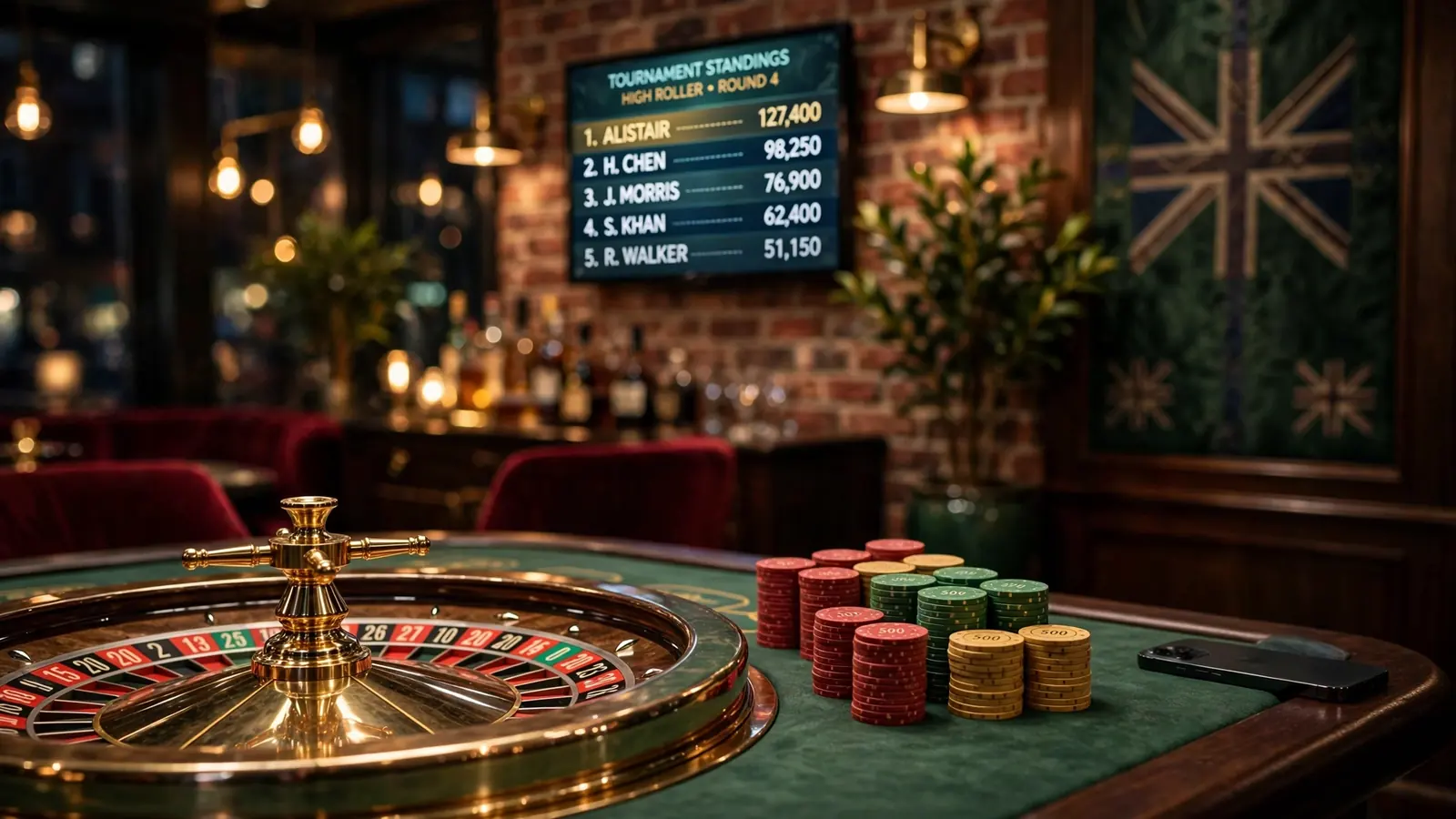
Table of Contents
- The UK Rules Behind Online Casino Tournaments
- Free Entry, No Deposit and Real-Money Prizes
- Casino Sites and Free Tournament Access
- Tournament Rules and Prize Terms: What Is Not Verified
- Payouts, Cryptocurrency and Jackpots: Claims to Check
- Tournament Strategy Without Unsupported Promises
- Practical Checks Before Joining a Slot Tournament
- What Can Be Verified About Slot Tournament Casinos
- Freerolls: The Term Does Not Verify an Offer
- Leaderboards and Tournament Results
The UK Rules Behind Online Casino Tournaments
An online casino tournament sits inside a wider gambling framework, but the existence of that framework does not confirm the status or terms of any particular event. I keep those questions separate. A regulator can oversee gambling activity and license businesses without thereby verifying every promotion, competition or tournament advertised by an operator.
In the UK, the Gambling Commission regulates gambling activity, including online casinos. For commercial gambling in Great Britain, it is the sole regulator. Its remit over remote gambling offered to consumers in Great Britain does not depend on where an operator’s key equipment is located. The relevant issue is the service being offered to consumers, not simply where the company or its servers are based.
That distinction matters when a tournament is promoted as an online event. The word “online” describes how it is accessed; it does not create a separate route around the licensing framework. Remote gambling operators serving consumers in Great Britain need the relevant Gambling Commission licence. A business operating from elsewhere is not exempt from that requirement merely because its equipment is outside the country.
Licensing also has more than one layer. The Commission issues operating licences to businesses and personal licences to individuals who carry out relevant roles in Great Britain. Those licences relate to the regulated operation and the people involved in it. They should not be read as an endorsement of every individual tournament or as proof that a specific event’s advertising, eligibility conditions or outcome has been checked by the regulator.
That is the point often blurred by promotional language. “Exclusive” can sound like a quality mark; in ordinary advertising it may simply describe restricted access or a particular promotion. The word alone says nothing about regulatory approval. Likewise, calling an event a slot tournament or a casino tournament identifies its broad format, not whether its operator is licensed or what rules govern participation.
When I assess the regulatory claim, I separate three things: the market framework, the operator’s status and the event’s own terms. The first concerns the laws and regulator that apply. The second concerns whether the business holds the relevant licence. The third concerns what the tournament actually offers and how it is run. Evidence for one does not automatically settle the other two.
Online American Roulette Casinos in the UK
This is why a general statement such as “regulated casino” cannot, by itself, answer every question about an online casino tournament in the UK. It may describe the operator’s position within the gambling framework, but it does not establish that a named event exists, that its rules are complete, or that a particular prize claim is accurate. Those are separate claims and need event-specific information to support them.
The reverse is also important: a tournament’s promotional page does not establish that its operator is licensed. The Commission’s role is regulatory, not a blanket validation service for marketing language. An event name, badge or label should not be treated as a substitute for confirming the relevant business status. Nor does the location of technical equipment decide the issue where remote gambling is offered to consumers in Great Britain.
The phrase “UK slot tournaments” can also conceal a jurisdictional distinction. The Commission regulates commercial gambling in Great Britain, while the legal framework is not identical across every part of the UK. The Gambling Act 2005 applies in England, Wales and Scotland, but not Northern Ireland. A broad label used in advertising should therefore not be taken as a precise account of which rules apply in every jurisdiction.
For readers comparing online casino tournaments in 2026, the sound starting point is modest: understand the difference between regulatory oversight and tournament verification. The Commission’s licensing system provides the framework for relevant gambling businesses and individuals. It does not, on its own, establish a competition’s mechanics or certify its promotional claims. I would not infer those details from the word “licensed”, from an event title or from a polished banner.
The framework is meaningful. It identifies who regulates commercial gambling in Great Britain and why remote operators serving that market fall within the licensing system regardless of equipment location. But a framework is not an event file. Tournament-specific claims need their own support, and the general rules described here should not be presented as proof of any particular online competition.
Regulatory Framework
A Gambling Commission licence provides the framework for gambling businesses and individuals in Great Britain, but it does not certify the mechanics or promotional claims of a specific tournament.
Recommended online casinos
- NightLuckBonus: Welcome Pack + 805% Up To 6400€ + 280 FS · Payout speed: 1-3 business days
- SlotoSportBonus: 500% up to £ 10 200+ 777 FS · Payout speed: 1-3 business days
- SpinFormulaBonus: 550% Up To £15,000 + 550 FS · Payout speed: 1-3 business days
- x3betBonus: Welcome Pack 100% Up to £1.000 + 200 Free Spins · Payout speed: 1-3 business days
- Revery PlayBonus: 100% up to€1,000+ 100 FS · Payout speed: 1-3 business days
- ZombillionBonus: Welcome Pack 250% up to £4000 + 200 FS · Payout speed: 1-3 business days
- ChanzeBonus: Slots Welcome Bonus #1 200% up to €500 · Payout speed: 1-3 business days
Free Entry, No Deposit and Real-Money Prizes
“Free entry”, “no deposit” and “real-money prizes” describe different things. A promotion might use one phrase without implying the others. Free entry says something about the cost of joining; no deposit suggests that a deposit is not required for participation; a cash prize concerns what a participant may receive. None of those labels, on its own, confirms the full offer.
I have seen how promotional wording can make separate conditions look like one attractive package. The careful reading is to separate the entry condition from the prize claim. A tournament described as free is not automatically a route to withdrawable cash. A no-deposit label does not itself establish who can enter or what a participant can win. And a stated cash prize would not, by itself, show that entry is free.
That distinction matters for searches about free online slot tournaments that promise real money in the UK. The wording combines two claims: that participation costs nothing and that the outcome may be a cash prize. The search phrase is not evidence that such an offer is available.
Free entry is not the same as no deposit
Free entry is about whether a fee is charged to take part. No deposit is about whether the participant must first put money into an account. The ideas can overlap, but they are not interchangeable. A free-entry offer could still involve account conditions; a no-deposit offer could still have restrictions on participation or on any benefit. Without the offer’s actual terms, neither label settles those details.
The wording can also leave an important gap: what exactly is free? It might refer to a specific tournament entry, rather than account use or any other activity. That does not establish a particular arrangement; it is a reason not to read more into the label than it says. In my experience, promotional shorthand is designed to catch attention, while the conditions define the transaction.
“No deposit” should not be read as “no checks” either. UK gambling safeguards require operators to verify a customer’s age before allowing a deposit. That requirement concerns depositing; it does not establish whether a particular tournament permits someone to enter before depositing, or what checks apply to its participants. The two questions should not be collapsed into one.
Online Casinos Without ID in the UK: What It Means
A prize claim needs its own basis
The phrase “win real money” raises a separate issue from entry cost. It signals a possible outcome, not proof of a prize, its form, or who would qualify. Searches for slot tournaments with cash prizes may therefore sound more definite than the information they provide.
A cash prize should not be assumed from the words “win”, “tournament” or “free”. Nor should a prize be treated as withdrawable merely because promotional language refers to money. The actual offer would need to state what the prize is and how it is awarded. Those are not minor details: they determine what the headline means in practice.
This is also why “free slot tournaments” and “slot tournaments for real money” are not opposing categories in a simple way. The first phrase is about the cost of entry; the second can refer to the stakes or the prize. A tournament could be described using both ideas, but the wording alone does not confirm that any particular combination exists. No assumptions should be made about an offer from a phrase typed into a search box.
Do
- Separate entry conditions from prize claims
- Check actual offer terms for withdrawable cash
- Verify if “no deposit” includes participation restrictions
Don’t
- Assume a free tournament always offers cash prizes
- Treat “no deposit” as a guarantee of no identity checks
- Infer the full offer from a single promotional label
Account limits are a separate safeguard
UK-licensed remote operators must prompt new customers to set a financial limit before their first deposit and provide accessible account-level limit controls. These are account safeguards. They do not certify that a tournament is free, confirm that a deposit is unnecessary, or verify a real-money prize.
That boundary is easy to miss when a promotion is presented alongside account features. A limit-setting prompt tells something about the operator’s obligations around deposits and account controls; it does not turn a promotional claim into a confirmed tournament offer. The categories do different work.
For anyone weighing a free-entry claim against a prize claim, the sound conclusion is narrow: the phrases identify different parts of a possible promotion, but none proves the others. The wording is not the offer.
Casino Sites and Free Tournament Access
A casino’s general promotions page is not the same thing as evidence that it offers slot tournaments. The distinction matters at site level: a banner can advertise promotions broadly, while a tournament is a particular feature that would need to be presented as such. A search for casinos with free tournaments is therefore not answered by a site’s ordinary welcome offer or by a list of casinos that merely provide online slots.
I would look for a clearly identified tournament area on the casino’s own website or app, rather than infer availability from promotional language. The page should make it apparent that the event is a tournament and that the casino itself is offering it. A generic phrase such as “free play” does not establish that a competition exists. Nor does a slot game’s presence on a site show that the game is being used in a tournament.
That is the point at which broad casino directories can become misleading. They may describe a casino as having promotions without distinguishing between an ongoing tournament, a one-off event, a prize draw or another kind of offer. Those formats are not interchangeable. A site-level description should identify the actual feature, not rely on a promotional label that could mean several things.
What a site listing would need to establish
A useful listing of online casinos with tournaments would need a basis for saying that each named site offers one.
Online Bingo in the UK: Rooms and Slots
I do not treat a casino’s reputation, size or number of promotions as proof of tournament access. Those details may describe the business, but they do not establish that a specific tournament is available. The same applies to a casino that offers many slot titles. A wide game catalogue and a tournament feature are separate things.
The UK context also matters when interpreting a site’s claims. The Gambling Commission regulates remote gambling offered to consumers in Great Britain, including where the operator’s key equipment is located elsewhere. A site’s own description should not be confused with regulatory confirmation of a particular promotion or tournament. Licensing and the existence of an event answer different questions.
Free access is a site-level claim
The word “free” can appear in different parts of a casino’s marketing. It may refer to a general promotion, a game feature or an event. Its presence on a page does not, by itself, establish that a tournament can be entered without payment. That question belongs to the specific event, not to the casino’s overall promotional identity.
This is why a page claiming that a casino has free tournaments should point to the tournament offer itself. A site-wide banner is not enough to show that the offer applies to a competition. Likewise, a casino may describe itself as having tournaments without establishing that any are free to enter. These claims should not be collapsed into one another.
For someone comparing sites, the most useful starting point is therefore not a ranking but a clear distinction between a casino’s general promotions and a named tournament feature. If the site does not present an identifiable event, a list entry saying “tournaments available” is difficult to assess. If it does, the event page—not the casino’s broad marketing language—is where its specific nature would be made clear.
I would not turn that distinction into a recommendation for a particular casino. No operator names belong in a list unless the claimed feature can be substantiated. A directory without that basis may look decisive, but it leaves the central point unanswered: whether the site actually offers the tournament being described.
For now, the sound editorial boundary is simple. Casino availability should not be inferred from a casino’s general slot catalogue, a vague promotions page or the word “free” in an unrelated offer. Site-level claims need site-level evidence. No shortcut.
Online slot payout percentages explained
Tournament Rules and Prize Terms: What Is Not Verified
A tournament label does not tell much about the competition behind it. “Slot tournament” sounds like a defined format, but it is only a description unless the operator publishes the rules that give it meaning. I would not treat the name, a promotional banner or a prize headline as a substitute for those terms.
For casino tournament rules to be useful, they need to explain how participation works and what determines an outcome. That could include which games count, how a score is calculated, when participation begins and ends, and how ties are handled. These are questions a rule page would need to answer; they are not standard conditions that can safely be assumed across tournaments.
That distinction matters. A polished promotion may communicate the appeal of an event while leaving the operative detail elsewhere, or may not make that detail clear at all. Until rules are available and readable, claims about how a tournament works remain just claims. Fine print matters.
What prize information should establish
The phrase “slot tournament prizes” can cover more than a headline amount or an image of a reward. Proper terms would need to identify what is awarded, who qualifies, how rankings relate to allocation, and what happens if an award cannot be claimed. Those details must come from the actual promotion, not from assumptions about how casinos commonly run competitions.
That means no reliable statement can be made about the number or type of awards, their value, distribution, or any conditions attached to them. A prominent prize figure, even when presented confidently, does not by itself show how many participants may receive it or what steps are required for delivery.
I have seen promotional wording do a different job from the rules: it gets attention, while the terms define the obligation. The reader needs both before judging what is on offer. Marketing is not the contract.
Reading terms as terms
If an operator publishes tournament conditions, the key test is whether they answer practical questions in plain language. The rules should identify the event they apply to and make clear how participation, scoring and prize allocation are governed. If separate documents apply, the relationship between them should be apparent. A generic promotions page cannot establish the terms of a particular tournament.
Attention: A regulator’s licence confirms an operator’s permission to offer gambling, but it cannot fill gaps in specific event terms or verify the details of a particular tournament.
This is not the same as asking whether entry is free or paid. The price of entry, if any, is a separate feature; the rules explain how the competition is administered and what the advertised award means. Nor does a statement that an operator is regulated verify the details of a particular tournament. Licensing and promotional terms are different things.
For a UK-facing real-money casino, the regulatory framework concerns the operator’s permission to offer gambling, not a universal tournament rulebook. I would keep those questions separate: whether the operator is authorised is one matter; whether a specific event has clear, complete conditions is another. A licence cannot fill gaps in event terms.
The sensible standard is documentary: an identifiable promotion, its applicable conditions and wording that connects the prize claim to the way it is awarded. Anything less leaves the essential mechanics unclear. No assumptions.
Payouts, Cryptocurrency and Jackpots: Claims to Check
A tournament promotion can sit beside claims about quick withdrawals, cryptocurrency deposits or large jackpots. The association is not evidence that the tournament balance follows the same payment terms, or that a jackpot forms part of the competition. I separate those claims before treating them as one offer.
“Fast payout” is a comparison, not a defined service standard. A withdrawal may involve a casino’s own processing and a separate payment provider; a tournament result does not, by itself, explain either stage. Without those details, a speed claim cannot be assessed as a promise about tournament funds.
Cryptocurrency raises a different question: whether a payment method is available for gambling at all, and on what terms. A search result or promotional label does not confirm that a UK-facing casino accepts crypto, that a tournament can be entered using it, or that winnings can be withdrawn the same way. I would look for the payment method and its conditions in the operator’s own published information, rather than infer availability from the word “crypto”. No assumption should fill the gap.
Jackpots also need to be separated from tournament prizes. A jackpot may describe a game feature, while a tournament prize would depend on the competition’s own stated arrangement. The two labels appearing together do not show that tournament play contributes to a jackpot, qualifies for one, or pays a jackpot award. Different things.
European Roulette Online Casinos in the UK: Odds
The practical check is whether the wording identifies what is being paid, by whom, and under which published conditions. A headline that promises “instant” payouts or a “massive” jackpot is not a substitute for the terms governing eligibility, payment method and withdrawal. Those are material distinctions, not fine print trivia.
For UK players, the payment context has firm boundaries. Licensed remote gambling operators cannot accept credit-card payments for gambling, including credit-card funding routed through a money service business. They also cannot accept wallet payments where credit-card funds can be used for gambling. These restrictions do not establish whether a tournament supports any other payment method, or how quickly a prize would arrive.
I would treat payout speed, crypto access and jackpot participation as three separate claims, each requiring its own clear terms. A tournament title alone settles none of them.
Tournament Strategy Without Unsupported Promises
A strategy for a slot tournament depends on how that particular competition works. Without its scoring method, eligible games and entry conditions, advice about which slots to choose or how to pace play is guesswork. I would not present any approach as a reliable way to win.
Promotional language such as “strategic play” can make a competition sound more controllable than it is. In practice, the word may describe nothing more than a suggestion to understand the format before taking part. It does not establish that skill changes the result, that one style of play scores better, or that past performance predicts future outcomes.
For an online slot tournament, the crucial distinction is between a general observation and a rule that actually applies. A player might assume that a particular game, bet pattern or session length gives an advantage. Unless the competition’s published terms explain how scores are calculated and what actions count, that assumption has no firm footing. Nor can a method be transferred from one tournament to another merely because both use slots.
I have seen how advice can become part of the sales pitch: a confident-sounding “system” gives an uncertain outcome the appearance of control. That framing suits promotion. It does not amount to evidence. A responsible account of slot tournament strategy therefore has to stop short of promising a winning formula or implying that disciplined play guarantees a better finish.
Mines Casino Game in the UK: How It Works
The practical strategic question is narrower: can the competition’s format be understood before joining? Its stated scoring basis, eligible games and any restrictions would need to be clear enough to assess what participation involves. If those details cannot be established, there is no sound way to compare tactics or claim that one is more effective. That is not a hidden technique. It is a limit on what can honestly be said.
This also keeps ordinary slot play separate from tournament performance. Familiarity with a game does not, by itself, show how a tournament ranks players or awards results. The competition’s own documented mechanics would have to make that connection. Without them, confident instructions are just confident wording.
No winning method can be responsibly asserted for online slot tournaments as a category. Specific rules matter. Claims need evidence.
Practical Checks Before Joining a Slot Tournament
Tournament tips often promise an edge, but they cannot replace checks on the play environment. I separate those two things. A competition label does not change the safeguards that apply to online slots in Britain, and it does not make an unverified strategy reliable.
The first practical point is how a slot can be played. Autoplay is banned for online slots in Britain. A spin must also run for at least two and a half seconds before the next game cycle can begin. Those rules matter when promotional language suggests that repeated play can be made automatic or accelerated: the regulated game itself must still follow the required controls. No shortcut around them.
Age checks are another basic safeguard. An operator must verify a customer’s age before allowing a deposit into a gambling account. Remote operators must also prompt new customers to set a financial limit before their first deposit and make account-level limit controls accessible. These are account protections, not evidence that a particular tournament is suitable, available or beneficial.
I would also look at the payment route before play. UK-licensed casinos cannot accept credit cards for gambling, including credit-card funding routed through a money service business. A wallet cannot be used for gambling if it lets credit-card funds pay for it. A familiar payment logo does not override those restrictions.
Practical Joining Checks
- Verify the operator’s licence on the UK Gambling Commission public register
- Confirm the site displays licence information and a link to the register
- Ensure a financial limit is set before the first deposit
- Check that the payment method used is not a credit card or a credit-funded wallet
- Confirm the availability of an internal complaints process and an ADR service
A casino’s accountability arrangements matter too. UKGC-licensed operators must provide an internal complaints process and access to an approved Alternative Dispute Resolution service. They must also offer responsible gambling tools, including self-exclusion. Those safeguards do not settle a tournament dispute automatically, but they define routes and controls that should exist within the regulated service.
When an offer uses phrases such as “easy tournament tips” or “play at your own pace”, I read the wording literally rather than as proof of an advantage. The slot rules set boundaries on how play proceeds; they do not establish how a tournament scores, whether a particular tactic works, or what a participant might receive. That distinction is easy to lose in promotional copy. It is not a small one.
Before depositing, the operator’s licence can be checked on the UK Gambling Commission’s public register. A licensed site must also display licence information and link to its register entry. These checks establish regulatory status, not the quality or terms of a tournament. Keep the two questions separate.
What Can Be Verified About Slot Tournament Casinos
A casino’s regulatory status and its tournament offer are separate questions. In Great Britain, a business offering remote gambling to consumers must hold the relevant operating licence from the UK Gambling Commission. That licence is about the operator’s permission to provide gambling services; it does not, by itself, confirm that the casino runs slot tournaments.
I keep that distinction clear when assessing claims about slot tournament casinos. A casino may be licensed without any particular tournament being established, while promotional wording alone does not show who runs the site or what activity the licence covers. The name of a promotion is not proof of availability.
Aviator Casino Game in the UK: Sites and Rules
The Gambling Commission is the commercial gambling regulator for Great Britain. Its role is not to endorse individual casino promotions. A tournament claim therefore needs evidence about the specific offer from the operator, as well as a reliable way to establish the operator’s regulatory status. These checks answer different things. One concerns who may provide gambling; the other concerns whether a particular tournament is actually being offered.
For a British-facing remote casino, licence details should be available on the site and linked to the Commission’s public register. The register can help establish the licensed business and its status. It does not act as a catalogue of tournaments, nor does a listing prove that a slot competition is open to players.
That is the useful dividing line. Regulatory status is verifiable through the licensing system; tournament availability must be established separately. I would not treat a casino’s general reputation, a banner, or the word “tournament” as a substitute for those checks. Promotional language can describe an event, but it does not establish its terms or confirm that the event is live.
So the phrase “slot tournament casino” is not a regulatory category. It joins two ideas—a casino and a competition—without proving that a named operator currently offers one. No shortcut there.
Freerolls: The Term Does Not Verify an Offer
“Freeroll” sounds definitive: a tournament with no entry fee. In practice, the label is only a description until an operator’s published offer gives it substance. It does not, by itself, establish that a slot tournament is available, who can enter or what the competition awards.
I have seen promotional language do a lot of work in a small space. A bold label can suggest a complete offer while leaving the operative detail elsewhere—or leaving the reader with no clear way to establish what is being offered. The distinction matters. A page mentioning freerolls is not the same as a live tournament, and a reference to free participation does not establish the conditions attached to it.
Casino Dice Games in the UK: How They Work
For an online slot tournament, the useful evidence would be the operator’s own description of the specific event: whether it is open, how participation works, and what, if anything, is awarded. Without those details, the word “freeroll” cannot answer those questions. Nor can it establish that a named casino runs such an event for UK players. No inference should be drawn from the term alone.
That is not a technicality. Marketing copy is designed to attract attention; the terms are what define an offer. If the two do not line up clearly, the promotional label cannot fill the gap. A phrase such as “free tournament” may describe an intended format, but it does not prove the event’s availability or settle its conditions.
I would treat “freeroll” as a starting label, not a completed offer. The distinction is simple. A label names an idea; the event details establish what is actually on offer. Where those details are not presented, there is no sound basis for describing the tournament as available or for promising a particular outcome.
The same care applies to pages that group several promotions under a freeroll heading. A category name does not confirm that every listed event is current, open to a particular group, or attached to a prize. Those points need to be stated for the individual event, rather than inferred from its title.
In short, the word carries an implication, not proof. No more than that.
Leaderboards and Tournament Results
A leaderboard can make a competition look straightforward: names or player identifiers appear beside positions, and movement up or down seems to tell the story. But a displayed position is only useful when the method behind it is clear. Without that context, a ranking is a presentation, not an explanation of how participants reached it.
Live Dream Catcher Casino UK: What to Check
I separate three things that promotional material can blur: the table shown on screen, the method used to order entries, and the final result. They are not interchangeable. A live-looking display does not, by itself, explain what is being measured, when a position is assessed, or whether the visible order is final. Nor does the word “leaderboard” establish that every participant is being compared on the same basis.
That matters particularly for slot tournament leaderboards. The label alone does not tell an entrant whether a position reflects points, a score, a count of game outcomes, or another measure. It does not establish how ties are treated, whether positions update during play, or what happens when a competition ends. Those details belong to the specific tournament’s published explanation; they should not be inferred from the format of the table.
I have seen how a neat ranking can do persuasive work before its meaning is fully understood. A moving position creates a sense of momentum. A high place can look like evidence of strong performance. Neither impression substitutes for a stated measurement method. The display may be easy to read while the basis for comparison remains unclear.
Results need the same distinction. A screen showing a position at one moment is not necessarily the final classification, and a ranking does not on its own explain what follows from it. The wording around the result should make clear whether it is provisional or final and what the displayed order represents. If those points are not stated, the safest reading is narrow: the screen shows a ranking, and nothing more can be concluded from the label alone.
That is the useful test. A leaderboard should be read as a claim about ordering, not as proof of the system behind that order. Clear presentation helps. Clear definitions matter more.
What are the UK online casino licensing requirements?
Remote gambling operators serving consumers in Great Britain need the relevant Gambling Commission licence, regardless of where their key equipment is located. The Commission also issues personal licences to individuals who carry out relevant roles.
What are the differences between UK licensed and non-UK regulated online casinos?
A casino serving consumers in Great Britain needs the relevant Gambling Commission licence even if it is based elsewhere or its key equipment is outside the country. A non-UK regulatory status alone does not replace that requirement.
What licensing and regulations apply to online casinos in the UK?
The Gambling Commission is the sole regulator for commercial gambling in Great Britain, and remote gambling operators serving consumers there need the relevant licence. The Gambling Act 2005 applies in England, Wales and Scotland, but not Northern Ireland.
Published by the Xtraspin Casino team.