
UK Online Casino Rules, Payments and Player Checks
 Available in US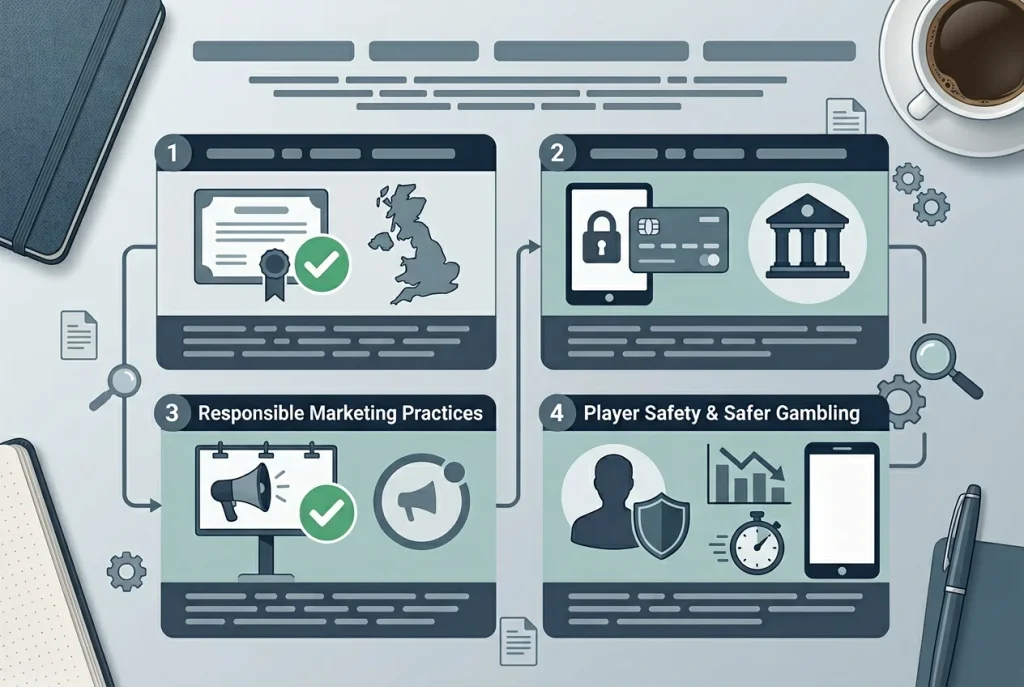
The Gambling Commission framework for online casino activity in Great Britain, used as the benchmark for reading a brand like Xtraspin without assuming it falls inside the perimeter.
The UK rules answer in brief
UK-facing online casino claims should be checked against Gambling Commission licensing, payment, advertising and consumer-protection rules. Those rules are central for Great Britain consumers, but they should not be assumed to apply to Xtraspin without operator-specific verification. The brand’s own terms contain a restricted-country clause covering the United Kingdom for deposits and real-money play, which means the Commission framework is the benchmark for reading the brand rather than the regulatory home of the brand.
The practical layers used across this cluster are: identify the licence evidence, read the operator’s current terms, check the payment restrictions that apply in Great Britain, look at how marketing and bonus copy is framed, and treat third-party review pages as leads rather than as proof. This page sets out the underlying UK context so Xtraspin-related claims elsewhere on the site can be judged against it.Five rule areas and what they mean for Xtraspin-related checks
| Decision area | UK context | How it applies to Xtraspin |
|---|---|---|
| Licence | The Gambling Commission regulates gambling businesses offering gambling in Great Britain, and remote gambling aimed at Great Britain consumers requires Commission licensing. | The UKGC licence check page is the workflow for confirming any positive authorisation claim about the brand. |
| Operator terms | Operator terms can restrict countries, payment use and account activity, and they bind the contract between the player and the operator. | The Xtraspin UK status page and the official restricted-country wording sit above any other operator content. |
| Payments | Credit cards are not permitted for online betting, casino or bingo gambling provided to consumers in Great Britain. | A UK cashier claim cannot rest on familiar payment logos; it needs current, operator-specific evidence consistent with Commission payment rules. |
| Marketing | UK gambling advertising must avoid misleading or socially irresponsible claims and must protect under-18s and other vulnerable groups. | Aggressive bonus messaging and “not on” framing are signals to slow down and verify the underlying status, not feature highlights. |
| Safer gambling | National self-exclusion, game-design controls and vulnerability checks are part of the licensed environment. | An offshore or restricted brand should not be presented as covered by UK tools unless the link to a Commission licence can be shown. |
Licensing as the first filter
The Gambling Commission is the regulator for gambling businesses offering gambling in Great Britain. Remote gambling services aimed at Great Britain consumers require a Commission licence even when the business is based abroad. That single point is the reason a UK reading should not lean on brand design, English-language copy or a third-party comparison table.
For Xtraspin, the cluster does not make a positive local-licence claim, and it does not make the opposite claim from an incomplete search. Public claims about the brand should be checked against the UKGC register, the operator’s current terms and the page-specific evidence. The public register verification guide sets out that workflow with the search routes that matter — legal name, trading name, domain and licence activity.
Great Britain and United Kingdom wording can also trip up a casual reading. UKGC sources typically frame consumer rules around Great Britain (England, Scotland and Wales). Xtraspin’s restricted-country wording uses United Kingdom, which also covers Northern Ireland. A careful page keeps the two distinct rather than flattening them into a vague “UK legal” headline.
Payment rules are local and method-specific
In Great Britain, gambling businesses must not accept credit-card payments for gambling in covered products, including online betting, casino and bingo. The rule is useful when reading any page that lists UK payment methods: a method table that includes credit cards for online casino use, or that does not explain how e-wallet funding is treated, is too loose for a cautious UK reading.
Even where credit cards are removed, debit cards, bank transfers, open-banking flows and e-wallets are not automatically safe. Payment availability is always operator-specific, country-specific and subject to identity checks. For Xtraspin, payment method lists found in third-party material should be treated as general unless they are backed by current official evidence and do not conflict with the restricted-country clause. The dedicated UK payment methods page keeps the question focused.
Recent rules have changed the UK reading checklist
Three recent regulatory threads matter for any 2025–2026 UK casino reading. First, light-touch financial vulnerability checks. The Commission’s published position is that operators must conduct these checks at £150 net deposits in a rolling 30-day period from 28 February 2025, after an initial higher threshold of £500 between 30 August 2024 and 27 February 2025. The checks rely on publicly available data such as County Court Judgments and bankruptcies; they are designed to be frictionless for most customers.
Second, online slots stake limits. From 9 April 2025, a £5 maximum stake per spin applies to online slots for adults, with a tighter £2 maximum stake from 21 May 2025 for players aged 18 to 24. These are direct game-design rules for Commission licensees offering online slots, not voluntary operator settings.
Third, the statutory gambling levy. The levy commenced on 6 April 2025 and is collected from Commission licensees by HMRC, with proceeds directed to research, prevention and treatment of gambling harms. It changes how harm-reduction work is funded and reinforces that Commission-licensed operators sit inside a coordinated safer-gambling system, not outside it.
For Xtraspin, these rules are still secondary to the country-clause caveat in the operator’s own terms. They are listed here because thin review pages routinely skip them, and the absence is itself a signal that a page is not engaging with the current UK reading checklist.
Market scale and why source hierarchy matters
The regulated Great Britain market is large and mature. UKGC industry statistics covering April 2024 to March 2025 reported total customer-facing Gross Gambling Yield of £16.8 billion, with £7.8 billion coming from the Remote Casino, Betting and Bingo sector. Within remote gambling, online casino games generated £5.0 billion, including £4.2 billion from online slots.
Those figures say nothing positive about Xtraspin. They explain why the casino search market is crowded, why bonus and payment pages compete heavily for attention, and why UK-facing claims need stronger evidence than they often carry. A large market attracts both regulated operators and thin comparison pages, so the source hierarchy — official operator terms, Commission register, payment and marketing rules, third-party commentary — does more work in a UK casino search than in a smaller market.
Safer-gambling checks belong inside the main reading
Commission research and government policy continue to flag online casino and slots content as the categories most associated with elevated risk. Gambling Survey analysis has shown online slots and online casino games with higher-than-average proportions of PGSI score 8-plus among past-year gamblers. The statutory levy is part of the funding picture that supports research, prevention and treatment in that space.
National self-exclusion is the other essential reference. GAMSTOP is the scheme for Great Britain residents and online gambling companies licensed by the Commission, and it forms part of a licensee’s safer-gambling obligations. A reader should not assume that a non-UKGC or restricted brand is covered by the scheme. That is why online slots safety and status checking belong inside the same reading rather than as separate boxes.
A five-point test for UK casino claims
- Can the page point to the relevant UKGC licence record by legal name, trading name and domain?
- Does the operator’s current terms page support the country and account claim being made?
- Are payment methods described without credit-card confusion for online casino use?
- Are bonus, marketing and safer-gambling tools described in a socially responsible way and consistent with current advertising rules?
- Does the page separate official evidence from reviews, user comments and search snippets?
The test is deliberately stricter than a feature checklist. A casino can have polished pages, familiar game categories and positive user comments while still failing the local evidence check. Repetition across affiliate pages does not strengthen a thin claim — it can become stronger only when the official terms, the public register, payment rules and safer-gambling context point in the same direction.
Topics covered in adjacent pages
Three adjacent pages handle the narrower decisions that sit alongside the rule framework. The winnings tax page covers the casual-player HMRC position and separates it from operator-side gambling duties. The UK payment methods page handles the cashier side: debit cards, e-wallets, open banking and the credit-card restriction for licensed operators. The online slots safety page extends the game-design and safer-gambling thread into the slot vertical specifically, including the stake limits noted above. None of those pages replaces the operator-side terms reading, because local regulatory context cannot override an operator’s own restricted-country wording.
Related UK checks
UK rules FAQ
Editorial information only. This site does not operate gambling services, accept bets or process payments.
See also: return to xtraspin casino for the full UK casino landscape.
See also: play safely with our guide to online slots safety.
Recommend
Published by the Xtraspin UK Guide team.