Fruit Machine Slots in the UK: How Online Reels Work
 Available in GB
Explore how digital fruit slots echo pub machines, how RNG outcomes work, and what to check in demos, paytables and bonus terms.
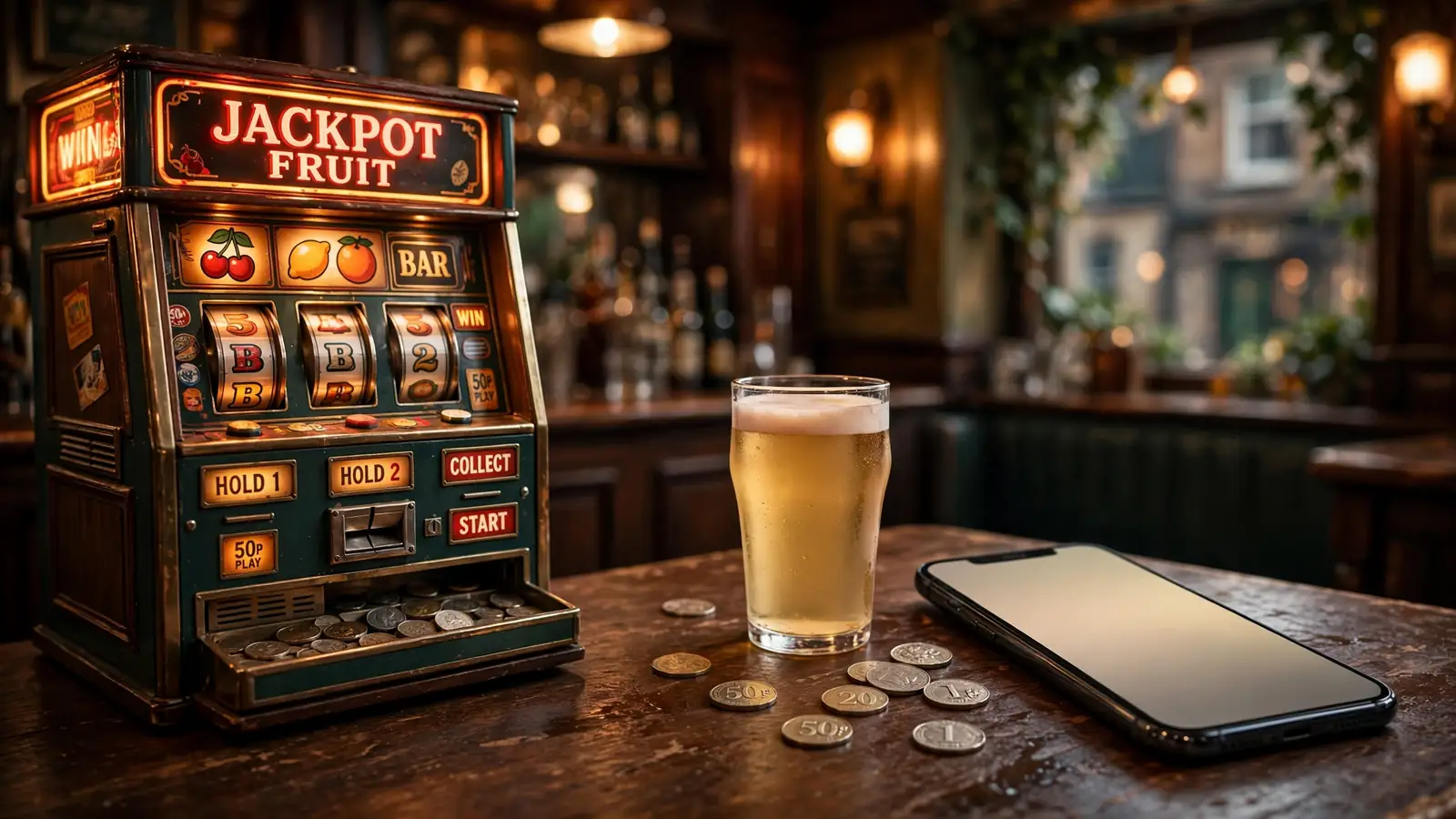
Table of Contents
- From Pub Fruit Machines to Digital Reels
- What “Online Casino with Fruit Slots” Means in the UK
- Real-Money Play: Verification and Stake Caps
- Named Fruit-Slot Styles, Not a “Best Games” List
- Fruit Slots in a Casino Game Library
- Online Features That Change the Session
- Classic Machines: Holds, Nudges and the Reel Layout
- Demo Play and the Paytable Details Worth Checking
- Fruit-Slot Bonuses: The Wagering Terms Behind the Offer
- “High Payout” Claims and What RTP Actually Shows
From Pub Fruit Machines to Digital Reels
The online fruit machine did not begin as a new kind of game. Its visual language came from physical machines: reels, familiar fruit symbols and a simple idea of matching symbols to form a result. The screen replaced the cabinet, but the basic format remained recognisable. That continuity is why a digital game can still feel like a pub fruity, even when its operation is entirely software-based.
The resemblance is not the same as identical mechanics. A physical machine and an online game may share the look of spinning reels, but digital fruit-machine-style games use modern systems to determine outcomes. A random number generator, or RNG, produces independent results. Each spin is its own event; the symbols shown on one spin do not make a particular result due on the next.
That distinction matters because the animation can suggest a mechanical process. Reels appear to turn and stop in sequence, and symbols settle into visible rows. The presentation gives the result a familiar shape, but it is not a set of physical reels slowing to a stop. The software determines the outcome, then presents it through the game’s visual design. Familiar appearance; digital operation.
I find that this is the useful way to understand the category: the format is inherited, while the machinery behind it has changed. Older fruit machines made their structure easy to read at a glance. Online versions retain that clarity in many cases, but can arrange their symbols and winning patterns in different ways. The reel grid is still a useful starting point, not a guarantee that every title follows the same rules.
A common modern arrangement has five reels, with three visible rows on each. That creates a rectangular grid of symbols, rather than the shorter layout associated with some classic machines. The visible rows provide the material for combinations, while the game’s paytable explains which symbol patterns count and how they are evaluated. Looking only at the artwork does not reveal the full rule set.
Many games using this grid have fixed paylines. A payline is a pre-set route across the reels on which matching symbols may form a winning combination. The route may run straight across or follow a more involved pattern, but it remains defined by the game. Modern fruit machines commonly provide between 10 and 50 fixed paylines. The exact number is part of the individual title’s structure, not a general rule that can be assumed from its fruit-themed appearance.
Penny Slot Machines in the UK: Costs and Odds
The word “fixed” is important. It describes the lines built into the game, rather than a route that changes freely from spin to spin. The layout tells the player where combinations are assessed; the paytable supplies the details of which symbols and sequences matter. Two games can look similar on screen yet use different line patterns, so the grid alone is not a full description of how a result is judged.
Some titles take another approach: 243 ways to win. Instead of relying on a set of drawn paylines, this system counts matching symbols across adjacent reels, with the symbols able to appear in different rows. The name describes the number of possible ways the reels can form combinations under the game’s rules. It does not mean that the game has 243 visible lines. Different structure, same need to understand the rules.
That difference is easy to miss when browsing online fruit slots. A familiar theme can sit on top of a conventional fixed-payline arrangement, or a ways-to-win format. The fruit symbols do not determine the game’s mathematics. The layout and its accompanying rules do. A title’s help or paytable screen is where those details are set out; the cabinet-style look is only the surface.
For UK players comparing fruit-machine-style games, the transition from physical machine to online reel is therefore more than a change of setting. The familiar symbols and spinning display carry over, while an RNG handles independent outcomes and the grid may use different methods to assess combinations. The five-reel, three-row format is common, but it is not universal. Fixed paylines and 243 ways to win are distinct structures, not interchangeable labels.
That is the category in plain terms: an old visual format carried into a digital game, with rules that vary by title. Familiar at first glance. Not identical underneath.
What “Online Casino with Fruit Slots” Means in the UK
An online casino with fruit slots is a gambling operator’s website or app that gives customers access to games in the fruit-machine style. The casino is the service provider; it is not necessarily the company that designed or supplied each game. That distinction matters. A familiar title may appear in more than one casino, while the operator controls the account, the way the games are presented and the terms under which its service is offered.
Playtech Casinos in the UK: Checks Before You Play
In ordinary speech, “casino” can mean the games themselves, the place they are played, or the business behind them. Online, those roles separate. A game provider builds a title, and a casino operator makes it available to its customers. The operator is also responsible for the gambling service it offers in the British market. A page full of fruit-themed games does not, by itself, establish who is providing that service or whether the operator is authorised to do so.
For UK online casinos with fruit slots, the central regulatory point is straightforward: an operator targeting UK players must hold a valid licence from the UK Gambling Commission. The requirement applies to the operator, not just to the game supplier. A supplier’s name or credentials do not replace the casino’s own obligation to hold the relevant licence. Nor does a polished website or a large selection of recognisable fruit machines answer the licensing question.
That is the line I keep coming back to when assessing an online fruit slots casino in the UK. The games may be the visible attraction, but the operator is the business relationship behind them. A licence is not a decorative badge. It places the operator within the UK regulatory system and provides the framework under which its gambling service is overseen. The licence must belong to the operator serving British customers, rather than being inferred from a provider whose titles happen to appear in the lobby.
The operator, not just the game
The phrase “online casino fruit slots” can make the catalogue seem like the whole story. It is not. A fruit slot online casino UK customers can access is also responsible for the service surrounding the catalogue. That includes the way it presents its offering and the processes through which gambling takes place. The underlying game and the casino’s operation are connected, but they are not the same thing.
I have seen how easily those roles blur in promotional language. A casino may lead with a game name or a familiar fruit-machine look, because that is what catches the eye. The important question sits behind the artwork: which business is accepting the customer and providing the gambling service? In the UK, that business needs a current Gambling Commission licence if it is targeting players here.
Licensing
Using an unlicensed offshore site means losing access to UKGC protections, as well as UK routes associated with services such as GAMSTOP and IBAS.
This is also why “best online fruit slots UK” is not a meaningful description of an operator on its own. A claim about a game selection says nothing conclusive about the status of the company offering it. Likewise, a broad phrase such as “best UK casinos with fruit slots” can mix two separate judgements: whether the catalogue suits someone’s taste and whether the operator is licensed to serve the market. One does not prove the other.
The distinction is practical rather than technical. A game may be recognisable, and the casino may look familiar, yet neither fact identifies the legal operator. The licence is attached to the business providing access, not to the fruit symbols, the game title or the general appearance of the site. That is the part advertising tends to leave in the background. The operator sits behind the reels.
What a UK licence establishes
The Gambling Commission’s licensing requirement applies to online casino operators targeting UK players. It means that a casino serving this market cannot treat an overseas location as a way around the British rules. The operator’s location does not remove the requirement to hold the appropriate UK licence when it sells into the UK market.
That point separates a UK-licensed casino from an offshore site operating outside the UK Gambling Commission’s regulatory system. An offshore operator may display games that look much like those found at a licensed casino, but visual similarity is not regulatory status. For UK players, the legal online gambling market consists of licensed and regulated sites. Using an unlicensed offshore site means losing access to UKGC protections, as well as the UK routes associated with services such as GAMSTOP and IBAS.
Novomatic and Amatic Games at UK Online Casinos
I do not treat those protections as a promise that every dispute will end in the customer’s favour. A licence is not a guarantee of a particular outcome, a winning session or a trouble-free experience. It is the regulatory basis on which the operator is permitted to serve the market, with oversight and routes that do not apply in the same way to an offshore business outside the UK system. A badge alone is not the point; the operator’s licence is.
So, when “online casino with fruit slots UK” is used as a description, it should refer to more than a collection of games. It means a casino operator offering fruit-machine-style games to British players under the required Gambling Commission licence. The game catalogue explains what can be played. The licence identifies whether the business providing that access is operating within the UK framework.
Recommended online casinos
- NightLuckBonus: Welcome Pack + 805% Up To 6400€ + 280 FS · Payout speed: 1-3 business days
- SlotoSportBonus: 500% up to £ 10 200+ 777 FS · Payout speed: 1-3 business days
- SpinFormulaBonus: 550% Up To £15,000 + 550 FS · Payout speed: 1-3 business days
- x3betBonus: Welcome Pack 100% Up to £1.000 + 200 Free Spins · Payout speed: 1-3 business days
- Revery PlayBonus: 100% up to€1,000+ 100 FS · Payout speed: 1-3 business days
- ZombillionBonus: Welcome Pack 250% up to £4000 + 200 FS · Payout speed: 1-3 business days
- ChanzeBonus: Slots Welcome Bonus #1 200% up to €500 · Payout speed: 1-3 business days
Real-Money Play: Verification and Stake Caps
Real-money fruit slots involve account conditions that do not apply in the same way to simply viewing a game. In the UK, a player must be at least 18 and register with verified identity before playing for money. Registration is not just a formality at the edge of the site: it connects play to an identified account, which is also where the operator must apply the relevant stake cap.
I have found it useful to separate two questions that are often blurred together in casino copy: whether an account is eligible to play, and how much it can stake on an individual spin. The first concerns age and identity verification. The second depends on the player’s age and is enforced by the operator. Neither is a feature of a particular fruit machine title.
Registration for real-money play requires the player to be at least 18 years old and have a verified identity.
Verification is an account condition
For fruit slots played with real money, registration must be tied to a verified identity. A profile that has not completed verification is not equivalent to an eligible, verified account. The requirement applies to the person playing, not simply to the device, payment method or game selected.
That distinction matters because online play can make the account feel like a thin layer between the player and the reels. In practice, it is the basis for applying the rules that govern real-money access. A person cannot treat a game being visible in a lobby as proof that real-money play is available to them. Access remains subject to the account requirements.
The age threshold is 18. That is the minimum age for real-money online gambling in the UK, but it does not mean every adult is subject to the same online slots stake cap. The cap is age-banded for players in Great Britain. Keeping those two points separate avoids a common misunderstanding: the minimum age determines who may register to play, while the age band determines the maximum stake per spin.
This is an account-level matter, not a choice left to the player during each session. A casino cannot make an account eligible to exceed the applicable cap by offering a different fruit machine or changing the presentation of the game.
Pragmatic Play Casinos UK: Amatic Is Different
The per-spin caps in Great Britain
For online slots in Great Britain, the maximum stake is £2 per spin for players aged 18 to 24. For players aged 25 and over, it is £5 per spin. These are upper limits, not suggested stakes or targets. A player can choose a lower stake where the game allows it, but the applicable cap cannot be raised by the player or waived by the operator.
The rule is framed around the spin. It does not mean that the same maximum applies to every adult: the age band matters. Nor should the figures be read as a general spending allowance. They limit the stake on an individual spin; they do not define what someone can afford to lose or make repeated play financially safe.
In my experience of how account rules are presented, the important operational point is less visible than the number itself. The operator must apply the limit at account level and must not allow a player to go over it. Compliance cannot depend on a warning that the player might ignore, or on the player remembering which age band applies. The control has to be built into the account’s permitted play.
That is why the cap should not be treated as a setting that can be negotiated through customer support, a promotional condition or a game-specific exception. It is a boundary on the account. If a game or interface appears to permit a stake above the relevant limit, that would not make the higher stake permissible.
Do
- Set a personal budget independently
- Treat gambling as entertainment spending
- Use a verified account
Don’t
- Treat the stake cap as a spending guide
- See the cap as a way to earn income
- Attempt to negotiate the cap via support
What the limits do—and do not—mean
A maximum stake is not a recommended stake. It says nothing about whether a session is affordable, and it does not turn gambling into a way to earn income. I treat the cap as a compliance ceiling, not as a spending guide. A personal budget should be set independently, with money used for gambling regarded as entertainment spending that may be lost.
The cap also does not replace the identity requirement. A verified account still has to be used by someone who meets the age threshold, and the correct age band still determines the stake limit. These checks work together: verification establishes who the account belongs to, while the cap restricts how much that account may stake on a spin.
Real-money play therefore starts with eligibility, not with a game choice. The account must belong to an adult whose identity is verified, and the operator must keep stakes within the applicable Great Britain limit. Those are fixed conditions of access. No workaround.
Named Fruit-Slot Styles, Not a “Best Games” List
Rainbow Riches is a useful example of how a familiar fruit-machine name can travel between physical cabinets and online games without every version being the same experience. The franchise began on Barcrest machines in British pubs, arcades and betting shops in 2006. It reached online play around 2009, carrying a name already associated with the pub fruity into a different format.
That history matters because “traditional” can describe a theme or a point of origin, not necessarily the way a game now works. A Rainbow Riches title on a screen may share its branding with a cabinet game while using a digital format. The name alone does not establish identical rules, features or returns. Familiarity is not sameness.
New Online Casino Sites in the UK: Amatic Explained
The franchise also shows why a list of the “best” fruit-themed games would be a poor fit here. A ranking needs a stated measure: one game might suit someone looking for a recognisable brand, while another may be distinguished by its format. Without a consistent basis for comparison, a numbered winners’ list would present preference as fact. These titles are better treated as examples of variety within a recognisable family.
One name, several versions
Rainbow Riches is the central name, but the available titles include Rainbow Riches Pick’n’Mix, Rainbow Riches Megaways and Rainbow Riches Freespins. The subtitles help distinguish products; they should not be read as proof that each title follows the same layout or has the same rules as the original. That has to be established from the particular game, not assumed from the franchise.
Rainbow Riches Megaways has a clear format marker. Megaways games use reels whose symbol counts can change from spin to spin, creating as many as 117,649 ways to win. That is a different structural idea from a fixed set of paylines. It gives the Rainbow Riches name a route into a changing-reel format, rather than simply repeating the fixed identity suggested by an old cabinet.
Pick’n’Mix and Freespins also show how subtitles can give a game a distinct identity inside a franchise. The words are useful labels, but they are not a substitute for the game’s own rules. A title should not be taken as a complete description of how a feature works, when it appears or what conditions apply. The details belong to the individual version.
Rainbow Riches Pick’n’Mix
A version of the franchise with its own distinct identity and rules.
Rainbow Riches Megaways
Features changing reels with up to 117,649 ways to win.
Rainbow Riches Freespins
A specific version of the franchise with a focus on free spin features.
Two other named examples, Piles of Cash and Rainbow Reveal, widen the set of fruit-themed titles without needing to be forced into a league table. Their names distinguish them as separate games; a name by itself does not establish their mechanics or comparative quality. That is a small distinction, but an important one in a category where familiar artwork can make different products seem more alike than they are.
Cabinet history and online versions
The physical and online Rainbow Riches versions also differ in a measurable way. Physical machines are generally set to pay out less than the online version’s 95% RTP. That comparison belongs to the versions described; it should not be stretched into a claim that every online fruit machine has a higher return than every physical machine. A shared title does not make every setting interchangeable.
In my experience, the commercial value of a well-known cabinet name is recognition: it gives players an immediate reference point. The less visible part is that the reference point can hide changes between builds. The game name may stay stable while its format and published settings differ. A familiar badge is not a specification.
So Rainbow Riches works less as a single “best” game than as a small case study in how fruit-machine-style entertainment has developed. Its cabinet beginnings connect it to British pub and arcade culture; its later online titles show that the same branding can sit across distinct products, including a Megaways version. The useful comparison is between named versions and what each actually contains, not between a supposed winner and the rest. Familiar, not identical.
Stakelogic Slots in UK Casinos: What the Evidence Shows
Fruit Slots in a Casino Game Library
A fruit-themed title is one part of a casino’s wider slot selection, not a separate kind of game system. In a fruit slot casino UK library, familiar symbols and themes may sit beside games built around different ways of forming wins. The artwork can suggest a traditional pub fruity, while the rules underneath follow a more modern structure.
One common alternative is the “243 ways to win” model. Rather than requiring symbols to land along a set of marked paylines, it counts matching symbols appearing across adjacent reels, in any position. That changes how a result is read: the player is looking for matching symbols across the reels, not tracing a line through a grid. The label describes the game’s win structure; it does not mean that every spin produces a win.
Megaways titles take a different approach. Their reel system changes the number of symbols shown on each reel from spin to spin, so the number of possible winning routes changes too. The format can produce as many as 117,649 ways to win. That figure describes the maximum number of ways available under the system, not a prediction of how often a winning result will appear.
I have found that game menus can make these formats look more alike than they are. A thumbnail tells little about how a title counts a win, and fruit imagery does not identify the reel mechanics. The useful distinction is in the game rules: fixed paylines, ways to win, or changing reels each shape how matching symbols are evaluated.
Common Win Structures
- Fixed Paylines: Pre-set routes across the reels where matching symbols form wins.
- 243 Ways to Win: Matching symbols across adjacent reels in any position.
- Megaways: A changing reel system that can produce up to 117,649 ways to win.
This variety matters when browsing fruit machine casino games in a larger library. Two titles can share a bright, familiar theme yet ask the player to understand quite different layouts and win conditions. Others may use a fruit-machine look while adopting a structure associated with newer slot formats. The category is therefore visual as much as mechanical: the theme may be recognisable, but the paytable and game information explain what the symbols actually do.
The catalogue is a mix, not a single template. A fruit theme can sit on several kinds of reel system, while a modern format can appear under many different themes. The rules matter more than the picture.
Online Features That Change the Session
An online fruit machine can keep the familiar spin at its centre while adding controls and bonus features around it. A specialist review may describe free spins, pick-style mini-games, autoplay, quick spin or mobile compatibility, but their presence is title-specific. The game’s own interface shows what is available; the labels alone do not explain every condition.
Free spins separate a feature round from ordinary play: spins are awarded within the game rather than started as separate paid spins. The details matter. A title may explain how the feature begins and what happens to its winnings in the game information. “Free” describes the spins, not necessarily every condition attached to a feature.
Pick-style mini-games interrupt the reel sequence with a choice between on-screen items. The selection may reveal a prize or another feature, depending on the title’s rules. I have found that these screens can make a game feel more hands-on, but the choice should not be mistaken for control over the underlying outcome.
Autoplay starts a series of spins without requiring a separate press each time. It changes the pace, not the game’s rules. Quick spin shortens the animation between starting a spin and seeing its result; it does not make a result more likely. Both controls can make a session move faster than intended. Small interface change. Noticeable effect.
Wazdan Online Casinos in the UK: Amatic Explained
Mobile compatibility means a game can be used on a phone or tablet, with its controls and display arranged for a smaller screen. That can make the same title accessible away from a desktop, but it does not make the experience identical: buttons, menus and information panels may be presented differently.
These features are part of the game interface, not a promise of a particular experience across every fruit machine. When comparing titles, the useful distinction is between presentation and rules. Faster animations and extra choices change how a session feels; the game information explains what those features actually do.
Classic Machines: Holds, Nudges and the Reel Layout
The classic fruit-machine format strips the game back to a three-reel layout and a single payline. With fewer symbols in view and fewer features around the spin, the attention falls on whether the symbols settle into a matching line. It is a different rhythm from a modern game with a larger grid and several ways to form a win.
Two familiar features can interrupt that simplicity: holds and nudges. A hold lets a player keep a selected reel in place while the others spin again. A nudge shifts a reel by one position after a spin, bringing a different symbol towards or into the payline. Both create a choice about what to do with the symbols already showing. A small decision point, not a change of game.
The terms can sound more powerful than the mechanics are. Holding a reel does not make its symbol more likely to complete a line, and nudging is not a way to steer the random process behind the result. These features alter the sequence of choices and add variety to the play; they do not change how outcomes are determined. That distinction matters. Control over a feature is not control over the result.
There is no single rule for how many holds or nudges a title provides, or when they can be used. A specialist review may describe multiple opportunities or conditions attached to a particular game, but that should not be treated as a rule for classic fruit machines as a whole. The game’s own feature instructions determine what is available in that version.
When I check a stripped-back game, I separate the visible choice from the underlying odds. The reel may be held, or a nudge may be offered, but neither makes a near-miss into a promise. The format is deliberately easy to read; the conditions still matter. Simple surface. Random outcome.
Demo Play and the Paytable Details Worth Checking
A demo is useful for understanding a fruit machine before staking real money. It lets the game run without cash play, so the rules and paytable can be inspected without a financial commitment. I treat that as a chance to learn what the symbols pay, how winning combinations are described and what conditions apply to any features. It is not evidence that a game will produce the same results in real-money play.
The paytable is the practical reference, not the short description beside a game tile. Open the game’s help or information screen and look for the rules attached to that specific version. The layout, symbol values and feature conditions belong to the game build being offered, so a familiar title alone is not enough to establish how it works.
RTP needs the same care. A specialist game review reports that published RTP can differ between versions of the same title. That makes the casino’s own paytable the relevant place to check the figure for the version available there; a number quoted elsewhere may describe another build. The distinction is easy to miss when game names match. The details matter.
Demo play can also make the wording in the rules easier to follow. A feature may have conditions that are clearer after seeing the relevant screen than they are in a brief catalogue description. Still, a demo does not settle every question about the version offered for real-money play. The paytable and game information shown at the specific casino remain the reference point.
Check Before Playing
- Use the demo to understand game operation
- Open the paytable to check symbol values
- Confirm the published RTP for the specific build
- Read the rules for any included features
I would separate two checks: use the demo to understand the game’s operation, then read the paytable to confirm the published details. Neither turns an RTP figure into a prediction of what a session will return.
Fruit-Slot Bonuses: The Wagering Terms Behind the Offer
A fruit-slot bonus has two separate sets of conditions: the regulatory limits on the incentive and the operator’s rules for using it. I have found that promotional wording often gives the first impression; the detail that determines whether play contributes to a withdrawal is in the terms.
Under the UK Gambling Commission’s Social Responsibility Code 5.1.1, wagering requirements on bonus funds cannot exceed 10 times the bonus amount. The limit applies to the amount that must be staked before bonus-derived funds can be withdrawn. It does not mean every bet qualifies, or that meeting the stated requirement guarantees a particular return.
Rules on wagering requirements and mixed-product incentives took effect on 19 January 2026. Under the Great Britain rules, one incentive cannot combine different gambling product types, such as casino play with betting, bingo or lottery products. A promotion needs to be structured around a single product type; the restriction is not a general ban on casino bonuses.
That regulatory ceiling is only part of the practical check. The live terms still determine which games are eligible and how much each contributes towards wagering. A fruit slot may be excluded, or count at a reduced rate, even when it appears in the same casino library as eligible games. A large selection does not tell the whole story.
I read “bonus” as a conditional offer, not extra cash. The important details are the wagering multiplier, the eligible-game list, contribution rates and any other stated conditions. Those terms can affect how much play is required in practice, even when the headline requirement sits within the legal limit.
A specialist review may describe common contribution patterns, but individual offers can change. The operator’s current promotion terms are the relevant place to confirm the rules before opting in. Check the live wording, not an old summary.
“High Payout” Claims and What RTP Actually Shows
“High payout” sounds like a promise about what happens after a spin. It is not. In fruit-machine-style games, the figure usually being invoked is return to player, or RTP: a published percentage describing the share of stakes a game is designed to return over a very large number of plays. It is a statistical measure, not a forecast for one player’s session.
For UK fruit-machine-style slots, the typical RTP range is 94% to 97%, although some titles sit outside it. That range gives useful context for a published figure, but it does not rank every game or say which one will pay out next. A result can differ sharply from the long-run figure over a short session. The same is true in reverse: a favourable run does not show that a game’s underlying return has changed.
I have seen “high payout” used as if it meant frequent wins or a reliable route to a profit. Those are different claims. RTP describes an average return across extensive play; it does not specify how wins are distributed, how often they occur, or when a particular session will end ahead. The wording sells certainty that the measure cannot provide.
A higher published RTP can indicate a larger theoretical return over the long run, but it cannot remove chance from an individual result. Nor does the label tell the whole story of a session. The useful distinction is between a game’s published statistical return and the outcome any one player experiences.
I treat RTP as context, not a target or a guarantee. “High payout” is promotional shorthand; the percentage beneath it is the more precise claim, and its meaning remains long-term. For a single session, the result is uncertain. That is the point.
Can I play fruit slots for real money in the UK?
Yes, if you are 18 or over and play with an operator holding a valid UK Gambling Commission licence. You must register with verified identity.
How do holds and nudges work in online fruit machine slots?
A hold keeps selected reels in place while the others spin again; a nudge shifts a reel by one position after a spin. Their availability and conditions vary by game, and neither changes the random process that determines outcomes.
What is the RTP of Rainbow Riches?
The online version of Rainbow Riches has an RTP of 95%. Physical machines are generally configured to pay out less.
What controls help manage my play?
Many UK-licensed operators offer deposit limits, session reminders and reality checks, which may appear every 30 or 60 minutes. GAMSTOP can block you from gambling with participating operators for six months, one year or five years.
Created by the ”Xtraspin Casino” editorial team.