Safe Online Casinos in the UK: Licence and Checks
 Available in GB
Understand what a UKGC licence does—and where its protections stop—alongside practical checks around bonuses, payments and play.
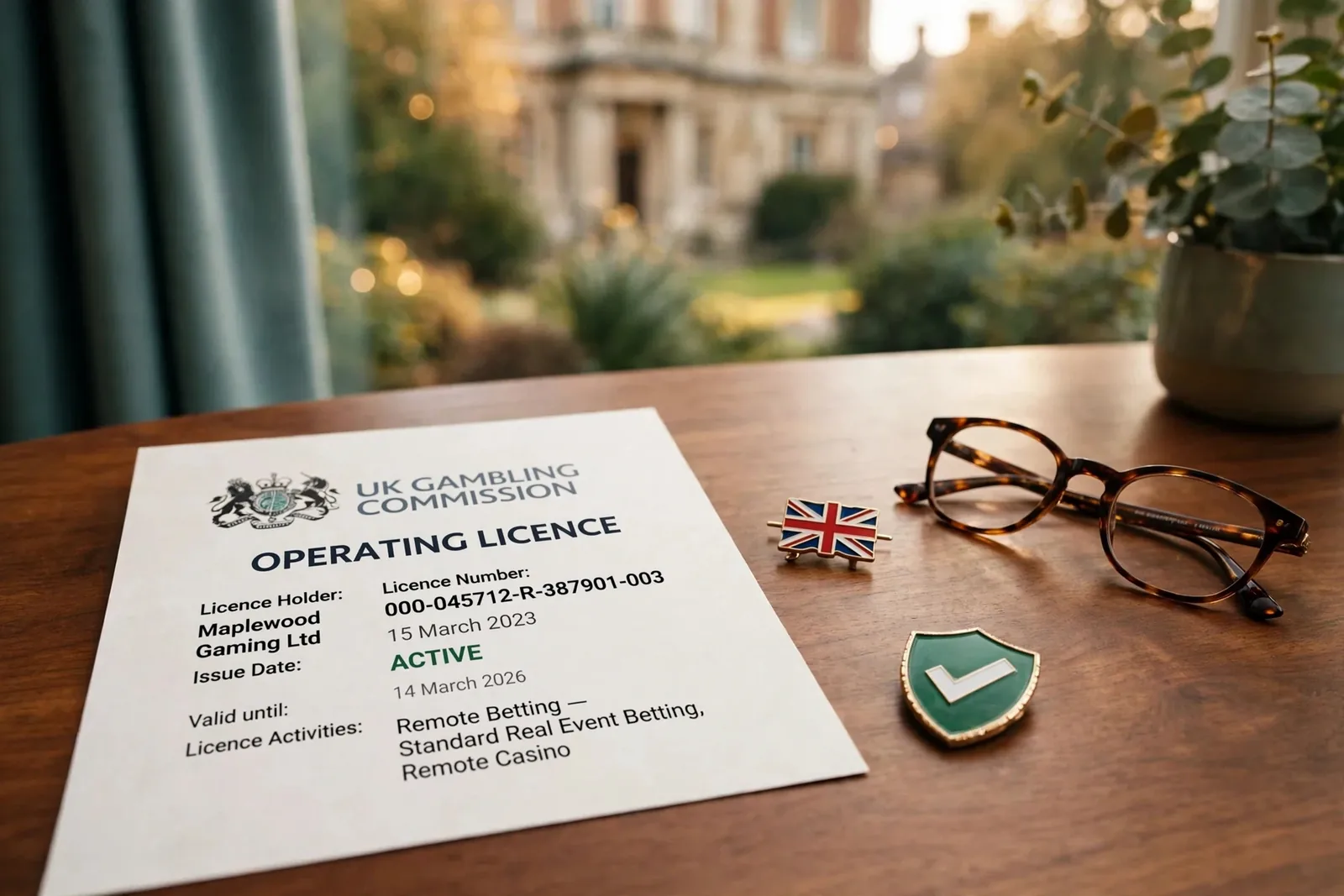
Table of Contents
- What a UKGC Licence Actually Tells You
- Checking a Casino’s Licence Before Depositing
- Offshore Casinos: Different Rules, Different Protections
- Real-Money Play, Limits and Affordability Checks
- A Licence Check Is Only the First Step
- Bonus Maths: What the Wagering Requirement Really Costs
- Secure Payments and the Limits of Crypto Speed
- Slot Rules That Change the Pace of Play
- Deposits, Withdrawals and Getting Verified
- Casino Apps and the Tools Behind Safer Play
What a UKGC Licence Actually Tells You
A UKGC licence is the basic legal distinction between a casino authorised to serve British players and one that is not. The UK Gambling Commission regulates gambling operators serving the British market, and a casino must hold the relevant licence to operate legally for UK players. The operator’s location does not change that requirement: the question is whether it is offering gambling to people in Great Britain.
That matters because a licence is not simply a badge chosen by a casino’s marketing team. It represents the operator’s place within the British regulatory system. When I worked around the industry, I saw how easily “trusted” or “safe” could become advertising shorthand. Those words describe an impression. A UKGC licence is a regulatory status.
It is still important to be precise about what that status means. A licence does not promise that a player will win, remove the financial risk of gambling or make every decision by an operator feel fair. It means the casino is legally permitted to operate in this market under the Commission’s oversight. That is a meaningful safeguard, but not a guarantee of a particular result.
The licence is about the operator, not the game
People often assess an online casino through its surface: the games, the layout, the welcome offer or how quickly the account appears to open. Those features may shape the experience, but they do not establish whether the business is authorised to serve British customers. The licence applies to the gambling operator.
That distinction is useful when a site presents itself as a familiar brand. A polished website can make a business look established; it does not, by itself, make that business legal to serve players in Great Britain. The relevant baseline is whether the operator holds a UKGC licence. Without one, it cannot lawfully operate a casino for UK players.
I would not treat “licensed” as a general quality rating either. It answers a narrower question: whether the operator is within the British regulatory framework. It does not rank licensed casinos or tell a player which one is best. It is the starting point for understanding the site’s status, not a substitute for considering the terms and the way the account is run.
Online casino payouts in the UK: how RTP works
Player funds are treated separately
One practical requirement attached to UKGC licensing concerns the handling of player money. Licensed operators must keep player funds separate from their operating capital. In plain terms, the money held for customers is not meant to sit in the same pool as the funds the business uses to run itself.
That separation is easy to overlook because it is invisible during ordinary play. It does not change the display on the account screen, and it does not make a casino’s balance risk-free. But it is a structural protection: the operator is required to distinguish customer funds from its own business capital.
The wording in casino advertising can make safeguards sound absolute. “Protected” may suggest that nothing can go wrong; the more useful point is the actual requirement. Player funds and operating capital must be segregated. That is a concrete feature of the UKGC framework, not a promise that every possible problem is eliminated.
A licence therefore tells us something about how the operator is meant to sit within the market and how one important category of money must be handled. It does not tell us whether a particular player will enjoy the site, whether a bonus suits them or whether a session will end in profit. Those are different questions.
A baseline, not a verdict
When I assess a casino, I separate legal status from sales language. “Safe” can mean many things in an advert: a familiar name, a reassuring design or an easy sign-up. None of those is the same as being authorised to operate legally for British players. The UKGC licence establishes that regulatory baseline.
The distinction matters most before the finer details. If an operator is not licensed for this market, descriptions such as “UK-friendly” or “trusted by players” do not replace the legal requirement. If it is licensed, that is an important fact, but it should not be stretched into a claim that the site is risk-free or that every element of its service is suitable for every person.
Attention: A UKGC licence is a regulatory baseline, not a guarantee that a site is risk-free or suitable for every person.
A licence is also not an individual endorsement of a casino’s games or commercial choices. It places the operator under the Commission’s regulatory framework. The Commission regulates the operator; it does not decide whether gambling is a good fit for a particular person. That boundary is worth keeping clear.
In everyday terms, a UKGC licence tells me that the casino has the legal authority required to serve British players and belongs within the system that regulates operators in this market. It also brings requirements such as separating customer funds from operating capital. Those are substantial points, but they are not a complete judgement of a casino. The licence is the floor. Not the whole assessment.
Checking a Casino’s Licence Before Depositing
A licence badge on a casino’s homepage is a claim, not a check. It may be genuine, outdated, copied from another operator or displayed beside a brand that is not covered by the licence at all. When I assess whether an online casino is safe to use in Great Britain, I start with the UKGC’s public register and compare its records with the site itself. The details need to line up.
The Commission’s public register is the place to verify an operator’s UKGC licence. The casino should provide its licence information with a working link to that official registry. A badge that leads nowhere, or a generic line saying “UK licensed” without an identifiable licence number, leaves the central claim unverified.
Merkur Casino Online UK: Rules and Account Guide
Match the operator, not just the logo
Search the register using the licence number shown on the casino’s site, then check the entry against the exact website domain. A result for a similar name is not enough. The register should also match the trading name and the legal business operating the casino. Brands can be owned by a company with a different name, so I look for a clear connection between the public-facing site and the business named in the register.
This cross-check catches a common source of confusion: a company may have a legitimate licence, but that does not establish that every site using its name or branding is covered by it. A misspelt domain, an extra word in the web address or a different legal entity can change what the register actually confirms. Read the whole entry. Do not infer that one operator’s licence extends to a related-looking brand.
If the casino’s site and the register do not agree, the discrepancy needs an explanation before money or personal details are handed over. The same applies if the number cannot be found, the domain is absent, or the listed business appears unrelated. A polished site cannot resolve a mismatch. Neither can a familiar logo.
A missing identifiable entry matters beyond the label “licensed”. Without one, there is no basis for assuming that GamStop self-exclusion applies, or that UKGC-regulated alternative dispute resolution and UK-specific consumer-funds protections are available. That is not proof of what a particular business will do; it is a reason not to treat an unverified licence claim as protection.
How to Verify Licence
Search the Register
Use the licence number from the casino’s site to search the UKGC public register.
Match the Domain
Compare the register entry against the exact website domain to ensure they line up.
Verify the Business
Check that the trading name and the legal business operating the casino match the register records.
Age checks apply before play content
A licensed casino must establish a customer’s age before allowing a deposit into a gambling account. The check is not limited to the moment money is added, though. On licensed platforms, age verification is required before access to gambling-related content, including free game demos. A demo may involve no cash, but it is still gambling content for this purpose.
That distinction is easy to miss when a site presents a free slot as a harmless preview. The absence of a deposit does not remove the verification requirement. If a licensed platform allows access to gambling-related material first and treats age checks as something to complete only when withdrawing, its process does not match the required order.
I also expect the account to ask new customers to set a financial limit before the first deposit, with account-level controls available afterwards. That prompt is part of the regulated account setup, not a decorative safer-gambling message. It should be visible before funding begins.
What a register check can and cannot settle
A successful match confirms that the operator and domain are listed under a current UKGC licence; it does not answer every question about how a casino handles its terms or customer service. I keep the register check narrow and factual: number, domain, trading name, legal business. Those identifiers establish whether the licensing claim belongs to the site being used.
When something does not match, I do not fill the gap with assumptions based on the site’s design, its advertising or another brand’s reputation. I pause the decision. Exact identity first.
Anjouan casino licence in the UK: what it means
This page may receive a commission if a reader registers with a partner casino. That commercial relationship does not replace the register check, and it should not be confused with evidence that an operator holds a UKGC licence. A licence must be verified independently, against the Commission’s own record.
Recommended online casinos
- NightLuckBonus: Welcome Pack + 805% Up To 6400€ + 280 FS · Payout speed: 1-3 business days
- SlotoSportBonus: 500% up to £ 10 200+ 777 FS · Payout speed: 1-3 business days
- SpinFormulaBonus: 550% Up To £15,000 + 550 FS · Payout speed: 1-3 business days
- x3betBonus: Welcome Pack 100% Up to £1.000 + 200 Free Spins · Payout speed: 1-3 business days
- Revery PlayBonus: 100% up to€1,000+ 100 FS · Payout speed: 1-3 business days
- ZombillionBonus: Welcome Pack 250% up to £4000 + 200 FS · Payout speed: 1-3 business days
- ChanzeBonus: Slots Welcome Bonus #1 200% up to €500 · Payout speed: 1-3 business days
Offshore Casinos: Different Rules, Different Protections
An offshore licence is issued by a regulator outside the UK system. It may show that an operator is subject to rules somewhere, but it does not put that operator under UK Gambling Commission oversight. For a casino serving Great Britain, the distinction matters: a foreign licence does not replace the UKGC licence required to operate legally in this market.
I have seen “internationally licensed” used as if it settled the safety question. It does not. The protections attached to an offshore licence are not on the same footing as those associated with UKGC or Malta Gaming Authority oversight. The regulator, its requirements and the routes available when something goes wrong can all differ. A logo or licence claim, by itself, says little about what recourse a player would actually have.
What happens if there is a dispute?
Non GamStop casinos sit outside UK dispute resolution channels. That means a complaint cannot simply be assumed to follow the routes available through the UK-regulated system. An offshore operator may describe its own complaints process, but an internal process is not the same as access to UKGC-regulated alternative dispute resolution.
Offshore Risks
Non GamStop casinos operate outside UK dispute resolution channels and are not required to connect to the GamStop self-exclusion system.
The practical issue is leverage. If an operator rejects a complaint about an account or a balance, the player may have fewer familiar ways to challenge that decision. The precise route depends on the operator and its regulator; the existence of a foreign licence is not, on its own, proof that a dispute can be resolved through a UK body.
Likewise, a UKGC-regulated consumer-funds protection arrangement should not be assumed where there is no identifiable UKGC licence entry. The same applies to GamStop. Offshore operators are not required to connect to that self-exclusion system, so a player should not treat a site as covered merely because it accepts customers from Britain or displays general responsible-gambling language.
That gap matters most for someone relying on a central block to prevent access. A site outside GamStop may not receive or apply the self-exclusion instruction held by the UK scheme. This is a structural difference, not a setting that can be inferred from a casino’s branding.
The label does not change the legal position
The UK market rule is based on where the operator offers gambling, not simply where the business is registered. Remote operators selling into Great Britain need the relevant UKGC licence. An offshore casino that lacks it operates outside the UK regulatory framework, even if its own jurisdiction has issued a permit.
That does not make the player the party subject to criminal liability for using the site. It does leave the player without the UK protections that apply to a licensed operator. Those are separate points, and they are often blurred in promotional copy.
Curaçao Casino Licence in the UK: What It Means
I would treat “safe” as a claim that needs a defined meaning. Does it mean the operator has a UKGC licence, participates in GamStop, and sits within UK dispute routes? Or does it mean only that a foreign regulator has authorised the business? Those are not interchangeable descriptions of safe gambling sites in Britain.
A review can explain an operator’s stated licence and terms, but it cannot turn an offshore permit into UKGC oversight. Nor should a general assurance be read as confirmation of UK-specific consumer-funds protection or access to UK alternative dispute resolution. The boundary is regulatory, not cosmetic.
This site may receive a commission if readers register with a partner casino. That commercial relationship does not alter the operator’s licensing status or the protections attached to it. The useful distinction is plain: a foreign licence may impose rules, but it does not supply the UKGC framework or make GamStop participation compulsory.
Different regulator. Different recourse.
Real-Money Play, Limits and Affordability Checks
Real-money play is shaped by more than the balance shown on screen. The amount accepted on a game, the limits set on the account and any checks prompted by spending all affect what happens after a deposit. I have found that the wording around these controls matters: a maximum bet is not a target, and an account limit is not the same thing as a promise that play will remain affordable.
Slot Stake Cap
As of 9 April 2025, the maximum stake per game cycle for adults on online slots is £5.
A specialist casino review reports a minimum stake of £0.10 and bets of up to £100 per round at most UK casinos. That is a reported range, not a fixed rule for every operator or game. The permitted amount can depend on the game and its own rules. Online slots have a separate statutory cap: the maximum stake per game cycle is £5 for adults, a limit that took effect for all adults on 9 April 2025. A figure shown for one table game should not be read as applying to slots.
The practical point is to distinguish the game’s permitted stake from the account’s financial controls. Remote gambling operators must prompt new customers to set a financial limit before their first deposit, and provide accessible controls for changing account-level limits. These controls are meant to let a player set a boundary on deposits or spending; they do not alter the stake rules for an individual game. Nor does a limit make a casino safe simply because it is available. Its value depends on whether it reflects a realistic budget and is kept in place.
Affordability checks are a different mechanism. UKGC-licensed platforms must request income verification from players who meet certain criteria, with enhanced checks triggered at spend thresholds that are not disclosed in advance. That means the request may arise during an account’s use, rather than at a single threshold that every player can anticipate. It is a regulatory check, not a routine feature that can be reliably timed around a deposit.
Gibraltar casino licence in the UK: what it means
From the operator’s side, these checks can feel abrupt because the trigger is not published as a simple spend figure. From the player’s side, the useful distinction is between an account limit chosen in advance and an affordability review prompted by the operator. One is a control to set; the other is a request for evidence when specified criteria are met. Neither should be confused with a guarantee that losses will be prevented. Plain mechanics.
The same care applies to “safe” language around a welcome offer. A bonus does not change the stake cap or remove the need to consider the cash being put at risk; its conditions are a separate issue. Real-money games can be operated within the UK’s regulatory framework, but the presence of controls does not make every decision financially suitable. I would treat a stated limit as a boundary to understand, not as an endorsement of the amount available to wager.
This site may receive a commission if readers register at a partner casino.
A Licence Check Is Only the First Step
A licence entry answers one question: whether an operator appears in the regulator’s records. It does not settle whether the site’s identity is clear, whether its terms are workable, or whether the account process will be straightforward. I have seen a familiar logo and polished wording do a lot of persuasive work; neither replaces checking who is actually offering the gambling.
Before Depositing
- Verify the operator’s licence on the UKGC public register
- Check that the domain and legal business match the licence
- Read the terms and conditions for withdrawal and account rules
- Submit photo ID and proof of address for verification
The first pass is about consistency. The name on the site, the trading name in its terms and the legal business responsible for the account should make sense together. The website domain matters too: a licence claim attached to a different address is not proof that the site in front of the customer is covered. I would compare those details with the UKGC’s public register, using the licence number rather than relying on a badge or a generic statement.
Then I read the terms as operating instructions, not promotional copy. They should explain how account conditions work and what can affect a withdrawal. If a key condition is hard to find, described vaguely or appears to conflict with another clause, that is a reason to pause before registering. The word “trusted” is not a term of service. It is a label.
Account verification deserves attention before any deposit. Every licensed operator must verify identity before processing a withdrawal, so leaving the paperwork until that point can create avoidable friction. I would submit a government-issued photo ID and proof of address after opening the account and before funding it. A passport or driving licence can serve as photo ID; proof of address may be a utility bill or bank statement dated within the previous three months. Some operators may also ask for confirmation that the payment method belongs to the account holder.
A safe online casino is not identified by a single visual cue. I look for a coherent operator identity, terms that can be understood before play, and a licence record that matches the actual site. Those checks do not promise that every interaction will be smooth. They make it harder for a vague claim to pass as evidence.
Casinos Without a UK Licence: What It Means
If no identifiable UKGC licence entry can be found, do not assume that GAMSTOP self-exclusion applies. Nor should a player assume access to UKGC-regulated alternative dispute resolution or UK-specific consumer-funds protections. That is a material difference, not a technicality.
The same caution applies to recommendations. A casino may be described as “safe” in an advert or review, but the useful question is what can be independently verified. A licence claim, operator identity and readable terms are separate pieces of the picture. None should be inferred from the others.
I keep the decision process plain: verify the operator, read the conditions, and deal with identity checks before money is involved. No badge does that work.
Xtraspin Casino may receive a commission if readers register with a partner casino. That commercial relationship does not replace independent checks.
Bonus Maths: What the Wagering Requirement Really Costs
A bonus headline is only the starting figure. The terms decide what must be staked before bonus funds, and sometimes related winnings, can be withdrawn. The first detail to pin down is the calculation base: wagering may be calculated against the bonus alone or against the deposit and bonus added together.
Consider a £100 deposit that earns a £100 bonus. At 35x, a bonus-only calculation means £3,500 in required turnover. If the same multiplier applies to the combined £200, the requirement becomes £7,000. That is an illustration of how the wording changes the arithmetic, not a compliant UKGC incentive: wagering requirements attached to incentives must not exceed 10x. The lower figure is not automatically a good deal. Turnover still means placing bets, with the outcome uncertain.
Do
- Check if wagering is calculated on bonus only or combined funds
- Verify the game contribution rates for each game type
- Observe the qualifying stake caps per spin
Don’t
- Assume a larger bonus headline means a better deal
- Assume every game in the lobby contributes to wagering
- Exceed the stated stake cap when using bonus funds
The game contribution can make the target harder to reach than the headline suggests. A specialist review reports slots counting the full stake towards wagering, while table games may count only a fraction, such as 5% to 10%. If a £10 table-game stake contributes at 10%, for instance, only £1 counts towards the requirement. The terms for a specific offer determine which games qualify and how much each contributes; a game’s presence in the lobby does not establish that it is eligible.
Stake caps are another condition worth reading before play. A specialist review describes operators limiting qualifying spins to £5 while bonus funds remain active. A bet above the stated cap may not count as intended and could put the offer at risk under its terms. The exact rule belongs to the individual promotion, so the cap should not be assumed from one casino’s offer to another.
The product scope matters too. A single incentive cannot bundle more than one gambling product type, such as casino and betting. That restriction is separate from the wagering calculation: a promotion still needs clear terms showing the qualifying activity, contribution rates, applicable stake cap and withdrawal conditions.
I have seen “generous” used as if a larger bonus settles the question. It does not. The useful comparison is the amount of qualifying turnover, what activity counts, and what happens if a condition is missed. A clean-looking headline can conceal a demanding route to withdrawal.
Online Casino No Registration UK: What Checks Apply
Xtraspin Casino may receive a commission if a reader registers with a partner casino. That commercial relationship does not change the promotion’s terms, which should be assessed on their own wording.
Secure Payments and the Limits of Crypto Speed
Payment security is not a single feature that can be inferred from a padlock, a familiar payment logo or a quick withdrawal. I separate the route of a transaction from the operator’s handling of the account: a payment method describes how funds move, while it says little by itself about the business receiving them. For a UKGC-licensed operator, player funds must be kept apart from operating capital. That is a safeguard around how the operator holds money, not a promise that every transaction will be instant.
Crypto makes the distinction between processing and settlement especially visible. A withdrawal can be approved by the casino before the transfer is recorded on the relevant blockchain. A specialist review reports on-chain settlement within 10–30 minutes after operator processing. That timing concerns the network stage, not the time spent waiting for the operator to review or release a request; it should not be read as a guaranteed end-to-end withdrawal time. The two stages are separate.
The route also changes what “fast” means. Once a crypto withdrawal has been processed, the transfer still has to appear on-chain. A casino’s advertised processing speed cannot control that step, and a network estimate cannot establish how quickly the casino will authorise the payment. In my experience, promotional language tends to collapse those stages into one attractive claim. They are not one stage.
Crypto Withdrawal Process
Processing and settlement are two separate stages. A casino may approve a withdrawal (processing), but the funds only become available once the transfer is recorded on the blockchain (settlement), which typically takes 10–30 minutes.
For a secure online casino in the UK, the useful distinction is between payment handling and the protections attached to the operator. A crypto option does not itself demonstrate that a site is secure, nor does an on-chain transaction confer UKGC protections. Conversely, a licensed operator’s fund-segregation requirement is not evidence about the settlement speed of a particular payment route. Different questions; different evidence.
Before transferring funds, the stated payment route and the operator’s terms should agree. Any claim that a transaction is “instant” needs to be read carefully: does it refer to the casino’s processing, or settlement after release? If that point is unclear, the speed claim is not a useful measure of payment security.
Xtraspin Casino may receive a commission if a reader registers with a partner casino. That commercial relationship does not change how a payment route works, and it should not be confused with independent evidence of security. Short version: speed is not protection.
Slot Rules That Change the Pace of Play
A safe online slot game is not defined by its graphics or theme. In Great Britain, the rules governing how a session moves matter too. Two mechanics are especially visible: autoplay is unavailable on UKGC-licensed slots, and a minimum interval separates one spin from the next.
Autoplay was removed from UKGC-licensed slot games in 2021. A player must start each spin rather than set a machine to repeat spins automatically. That interrupts a continuous run of bets, but it does not decide whether a game is suitable or prevent someone from continuing manually. The distinction matters: a control can change the rhythm without removing the choice to play.
The other rule sets a minimum of 2.5 seconds between slot spins. The pause was introduced to slow play and reduce session intensity. It may look like a small delay in isolation; across a session, it prevents spins from being triggered in rapid succession. The requirement applies to the interval between spins, not a promise about how long a whole session will last.
From inside the industry, I learned not to read a safety feature as a verdict on the product. “Safer” can be an advertising word. Here, the concrete point is narrower: regulated slots cannot autoplay, and they cannot offer spins at a pace faster than the required interval. Neither rule tells anyone how much they will spend or whether they should continue.
This is also why a game’s appearance is a poor guide to its mechanics. Two slots can look equally simple while presenting the same regulated pace controls; the rules do not turn one into a risk-free option. Safe casino games in Britain still involve gambling, and these pace restrictions do not remove that underlying risk.
I regard the controls as friction, not protection in the absolute sense. They make rapid, unattended play unavailable on licensed slots, while leaving the session itself in the player’s hands. A useful distinction.
Slot Pace Controls
- Autoplay is unavailable on UKGC-licensed slots
- A minimum interval of 2.5 seconds exists between spins
- These restrictions slow play but do not remove gambling risks
Deposits, Withdrawals and Getting Verified
A payment option appearing on a cashier page does not, by itself, establish how a deposit or withdrawal will work. The route, the operator’s checks and the payment provider’s own conditions all matter. In a specialist review covering the brands assessed, bank transfers took 3–5 banking days; that is a reported comparison, not a universal settlement promise. The operator’s terms should explain whether the same route is available for withdrawals and what checks can delay processing.
PayPal is not a standard feature at non GamStop casinos. A specialist review found its availability conditional on PayPal approving the operator as a merchant, so a logo or mention on a payment page is not proof that the service will be offered to every account. Availability can change, and the operator’s cashier is where the current options appear.
Credit cards are different: remote gambling operators serving Great Britain cannot accept them for gambling payments. The restriction has applied since April 2020 and also covers a payment routed through a money service business when the underlying funds come from a credit card. A wallet cannot be used for gambling where it allows credit-card funds to be spent. A payment route that obscures the original funding source does not remove the restriction.
Verification is closely tied to withdrawals. Licensed operators must confirm a customer’s identity before processing one, and leaving that check until the account is ready to cash out can create avoidable delay. The standard documents are government-issued photo ID, such as a passport or driving licence, and proof of address dated within three months, such as a utility bill or bank statement. Some operators also ask for confirmation that the payment method belongs to the account holder. Submitting these documents after registration and before depositing gives the operator time to complete its checks before a withdrawal is requested.
I have seen payment pages make every route look equally straightforward. The conditions are in the details. The site may receive a commission if a reader registers with a partner casino; that does not change the need to read the operator’s payment and verification terms.
Casino Apps and the Tools Behind Safer Play
A casino app is another route into an account, not a separate regulatory category. Installing it, saving a password or using it on a phone does not reduce the protections a UKGC-licensed operator must provide. The same account-level controls should be available whether play takes place in an app or through the operator’s website.
Deposit limits are one of those controls. They let a customer set a ceiling on money going into the account; they are not a promise that gambling will remain affordable or a substitute for deciding whether to play. Time-outs offer a pause from gambling, while self-exclusion through GamStop is intended for a longer break across participating UKGC-licensed operators. These tools work at account level, not because a particular app has a reassuring design.
I have seen “safer play” used as a reassuring label on screens where the practical value depends on whether the controls are easy to find and understand. A polished interface is not itself a safeguard. The useful test is whether the account provides clear access to limits, time-outs and self-exclusion, and whether those options behave as the operator describes.
An app can also make an account feel closer at hand: notifications and saved access reduce friction. That is a design choice, not evidence of safer gambling. Controls matter more than the icon on the home screen.
A safe casino app in Great Britain is therefore not defined by appearance or convenience. Its protections come from the operator’s obligations and the account tools available within that relationship. If the app is simply a mobile wrapper for the same account, the safeguards should not disappear when the screen gets smaller.
The small print still matters. A limit, pause or exclusion option only helps when its scope is understood and the account settings are accessible. No shortcut.
Is it safe to play at online casinos in the UK?
A UKGC-licensed casino is authorised to operate legally for UK players and must provide safeguards such as deposit limits, time-outs and self-exclusion. A licence is an important baseline, not a guarantee that gambling is risk-free or that you will win.
Do all games count toward bonus wagering?
No. Slots count at 100% of each pound staked, while table games typically count at only 5% to 10%. Check the bonus terms for eligible games and any limits on bets while bonus credit is active.
What exactly are non-GamStop casinos and are they legal in the UK?
Non-GamStop casinos are operators not connected to GamStop, often operating under offshore licences. A casino must hold a UKGC licence to operate legally for UK players; offshore operators do not provide the same UK protections or dispute-resolution channels.
Can I find non-GamStop casinos in the UK accepting PayPal?
Some may accept PayPal, but availability is not universal and depends on PayPal approving the operator as a merchant.
Created by the ”Xtraspin Casino” editorial team.